
Fall Prevention for Older Adults: A Practical Guide
If you've just watched a parent steady themselves on a doorframe — or gotten the phone call every adult child dreads — the question is rarely "should we do something?" It's "what, in what order, without taking over their life?"
The direct answer: fall prevention for an older adult works best as a combined plan, not a single fix or product. Address the hazards and routines you can see, involve a clinician, pharmacist, or rehabilitation professional whenever there has been a fall, unsteadiness, a medicine concern, or a new symptom, and add strength-and-balance support that fits your parent — because most falls come from a combination of contributing factors, not one cause and not age alone. Two conditions govern the order. If a fall has already happened, checking for injury comes before everything else on this page. And nothing changes at home without your parent's agreement — which is a practical requirement, not only a courteous one.
If your parent has just fallen and may be hurt, stop here. Call 911 (or your local emergency number) if they are unconscious or hard to wake, confused, struggling to breathe, bleeding heavily, unable to move or bear weight without severe pain, or if you suspect any injury to the head, neck, or back — and when a head, neck, or back injury is possible, keep them still and do not try to lift or move them. The American Red Cross adds several signs families often miss: new confusion or a change in alertness, weakness, tingling or numbness, a sudden inability to do something they could do before, seizures, bruising around the eyes or behind the ears, and blood or clear fluid from the nose or ears. These are examples, not a complete list; when you are not sure whether it's an emergency, call 911. One more rule that surprises many families: a fall with any hit to the head deserves prompt medical attention even if your parent seems fine, especially if they take a blood thinner.

On this page
- What should you do first to prevent a fall?
- Why do older adults fall?
- Which fall risks need a clinician, pharmacist, physical therapist, or occupational therapist?
- How can strength and balance work reduce fall risk?
- How do you make a home safer room by room?
- What should you do after an older parent falls?
- How should a family prepare in case a fall happens?
- What can family change, and what needs professional help?
- The one-page fall-prevention plan: what your family should write down
- What should you do in the next 24 hours, 7 days, and 30 days?
- What fall-prevention mistakes should families avoid?
- How do you choose fall-safety support at a glance?
- What does Medicare cover for fall-safety equipment?
- Frequently asked questions about fall prevention
- Your next step
- About this guide
- Sources and last verified date
What should you do first to prevent a fall?
The first move is not a purchase and not a lecture. It's sorting out what kind of moment you're in — an emergency, a recent-fall concern that needs professional eyes, or a routine chance to make things safer — and then working a plan with three layers.
The Prevent–Assess–Respond plan
| Layer | The one-sentence job | Examples | What it is not |
|---|---|---|---|
| Prevent (fix now) | Address obvious, low-risk hazards and communication gaps, with your parent's agreement. | Clear a walking path, brighten everyday lighting, move often-used items within easy reach, make sure a phone or other way to call for help is reachable. | A complete risk assessment. |
| Assess (arrange a review) | Report any fall, unsteadiness, symptom, or medicine concern to the appropriate professional. | Clinician or pharmacist review; physical or occupational therapy, vision or foot care as advised. | A diagnosis, or a medicine or exercise prescription. |
| Respond (prepare a plan) | Decide how help would be summoned, who responds, and how they get in. | A reachable phone or wearable alert, a backup contact, an access plan, an emergency-information sheet, a date to test it. | Fall prevention — a response plan helps after a fall; it does not stop one. |
Where your family should begin depends on one thing — what has already happened.
- Call 911 now if your parent has fallen and may be hurt; the injury check above comes before everything else here.
- Start with a shared walkthrough and simple household fixes if there have been no falls and no new symptoms, and the concerns are things you can see, like clutter, loose rugs, or dim lighting.
- Arrange a professional assessment first if there has been a fall or near-fall, new unsteadiness or dizziness, or a medicine, vision, or foot concern.
- Build the response plan first if your parent lives alone and could not reliably call for help today.
- Choose none of these yet if your parent hasn't agreed to any changes — begin with a conversation, or a professional assessment, before any purchase.
Whichever branch fits, the smallest first step is the same: ask your parent to walk their highest-use routes with you this week, and write what you find into the one-page fall-prevention plan below, so the walk turns into a plan instead of a worry.
Start with the parent, not the house
It's tempting to open with the rugs. Open with your parent instead. Ask what feels unsteady, which activities they've quietly started avoiding, and which changes they would actually accept. This isn't just kindness — it's accuracy. Your parent knows which step wobbles and which hallway is dark at 2 a.m., and a plan they helped build is a plan they'll use. A simple opener: "I'm not trying to change anything without you. Would you walk me through the spots that feel least steady, and tell me which fixes you'd be OK with?" If the conversation itself is the hard part — if concern keeps colliding with "I'm fine" — start smaller and use the approach in our guide on how to talk with an aging parent about help.
Do a 10-minute first pass
Before the full room-by-room checklist, take one short walk together through the routes your parent uses most — door to kitchen, chair to bathroom, bed to bathroom. Look only for obvious hazards and communication gaps, and write down questions for later. This is a first pass, not a complete assessment.
| What you notice | Why it matters | Next step | Owner, and by when |
|---|---|---|---|
| Loose rugs, cords, or clutter on the routes they actually use | Trip hazards matter most on high-traffic paths | Move or secure them, with your parent's OK | Family — today |
| Dim or missing light where they walk at night | The half-asleep walk to the bathroom is unforgiving | Add night lights and a reachable lamp | Family — this week |
| A fall or near-fall they mention, or new unsteadiness | A fall is a signal to review, not a verdict | Note the details and call their clinician | Parent and family — this week |
| Medicine questions, including over-the-counter drugs and supplements | Effects can add up; only a professional should adjust them | Start a complete list to bring to a review | Parent and family — this week |
| No reliable way to call for help from where they spend time | Minutes matter after a fall | Agree on a reachable phone or help method | Parent and family — today |
A note on method: this guide draws on the CDC's STEADI older-adult fall-prevention initiative and falls-prevention guidance, the U.S. Preventive Services Task Force recommendation finalized in June 2024, MedlinePlus, the American Red Cross, and the Administration for Community Living. "Prevent – Assess – Respond" is our editorial way of organizing that guidance for families; it is not a validated clinical tool or risk score, and nothing on this page diagnoses anything or replaces professional advice. What this guide deliberately leaves out: prices for equipment and modifications, falls that happen inside hospitals and licensed care communities, rehabilitation after an injury, and named drug classes or specific exercises — each of those belongs with the page or the professional that owns it.
Why do older adults fall?
"They're getting older" is not an explanation, and treating it as one is how preventable falls get accepted. The CDC reports that more than one in four adults 65 and older falls each year — and fewer than half tell their doctor. One caveat belongs with that number: CDC publishes it in the summary of that page without a reference to an underlying study, so the most precise date we can attach to it is the page's own, last reviewed January 27, 2026 and checked here on August 1, 2026. The same page notes that falling once doubles the chances of falling again, which is a reason to report and review every fall, not a prediction about your parent. Most falls involve several interacting contributors, and many of them can be changed.
It is worth holding the other half of that statistic too, because fear makes families move faster than judgment. CDC publishes two injury figures for falls, and they are easy to mistake for a contradiction. The first is that about 37% of people who fall report an injury that needed medical treatment or restricted their activity for at least a day, drawn from an MMWR analysis of United States data for 2012–2018. The second, on the same page, is that about one in ten falls causes an injury of that kind, drawn from a 2021 review of fall risk factors. They disagree only if you assume they are counting the same thing. The first counts people across a year; the second counts individual falls, and a person can fall more than once in a year. Read the first as roughly your parent's odds over twelve months and the second as the odds attached to any single fall. Both carry the same practical message: most falls do not end in a treated injury. A fall is a reason to review the plan carefully. It is not, by itself, evidence that everything has changed.
Balance, strength, walking, and prior falls
Lower-body weakness and difficulty with walking or balance are among the most common modifiable risk factors the CDC identifies. A prior fall, repeated near-falls, or a new hesitance on stairs are signals worth acting on — not because they prove anything by themselves, but because they are exactly what a clinician or physical therapist can evaluate and often improve. Fear of falling belongs on this list too: the CDC notes that people who become afraid after a fall often cut back on activity, become weaker, and end up at higher risk — a cycle that responds to support, not to restriction.
Medicines, vision, feet, and lightheadedness
Some prescription medicines — and even some over-the-counter drugs — can affect balance and steadiness, and effects can stack when several are taken together. Vision problems, foot pain, and unsupportive footwear each contribute in their own way. So does feeling lightheaded or faint when standing up — clinicians call this postural hypotension, meaning a drop in blood pressure on rising from sitting or lying down, and the word is worth having when you describe what your parent is experiencing.
One place the sources differ is worth naming out loud. The CDC's list of modifiable risk factors includes vitamin D deficiency. The 2024 USPSTF falls-prevention recommendation covers exercise and multifactorial interventions and does not make a recommendation on supplementation. That is a change, not an oversight: the Task Force's 2018 statement did address it, recommending against vitamin D supplementation to prevent falls, and the 2024 update withdrew that position and moved the question to a separate review, which the Task Force records as in progress. So the current federal picture is neither agreement nor silence — it is one agency listing vitamin D deficiency as a contributing factor while the other has taken its falls-specific recommendation off the table pending review.
That review is not silent either, and this is the part most coverage of the question leaves out. In a draft recommendation statement posted December 17, 2024, the Task Force concluded with moderate certainty that vitamin D supplementation, with or without calcium, has no net benefit for preventing falls or fractures in community-dwelling postmenopausal women and men 60 or older. A draft is not a final recommendation — the Task Force's topic page still shows the update in progress, with public comment closed, as of August 1, 2026 — but it does show where the evidence review landed.
None of this settles whether your parent should take anything. That decision belongs with the clinician or pharmacist who can see the whole list.
One boundary is absolute: do not change, stop, or add any medicine or supplement on your own — bring the complete list, including over-the-counter drugs and supplements, to a clinician or pharmacist and let them adjust.
Home, task, and routine factors
Home hazards such as broken or uneven steps, throw rugs, and clutter round out the picture — but they rarely act alone. A nighttime trip may involve dim light, urgency, loose slippers, a medicine effect, and a rug edge all at once, which is why recording what you observe beats assigning a single cause.
| Person and health | Task and routine | Home and environment |
|---|---|---|
| Strength, balance, and gait; vision; foot pain; medicine effects; lightheadedness on standing; fear after a fall | Rushing to the phone or bathroom; carrying loads that block the view; climbing to reach storage; nighttime routes; unsupportive footwear | Loose rugs and cords; clutter on paths; poor lighting; uneven or broken steps; missing or loose rails; slick surfaces |
The columns interact — that's the point. A plan that touches all three will do more than a perfect version of any one.
Which fall risks need a clinician, pharmacist, physical therapist, or occupational therapist?
Families are good at spotting problems and terrible at being asked to solve all of them. The dividing line: you can change what you can see; professionals assess what's happening inside the interaction between your parent, their health, and their home.
Signals that it's time to schedule an assessment
Make the call when any of these is true: a fall, even a "soft" one with no injury; repeated near-falls — a stumble, slip, or grab for furniture that didn't end on the floor — or new unsteadiness; fear that is shrinking your parent's activity; new dizziness, lightheadedness on standing, or fainting; a new difficulty walking or rising from a chair; or a medicine concern, including anything over the counter. The CDC's caregiver guidance is blunt on the first item: falls and unsteadiness should be reported to a health care provider, even when your parent would rather not mention it. A fall you only heard about afterward still counts — many go unreported, as the section above notes, and a late report is still a report. There is no score to compute here; one true signal is enough to book the conversation.
What to bring to the appointment
Bring the complete medicine and supplement list (or the actual bottles), your written notes on any falls or near-falls — when, where, doing what, wearing what, and how your parent felt before and after — the shoes and any cane or walker your parent actually uses, and two or three questions your family most wants answered. Observations travel better than conclusions: "she felt lightheaded when standing" gives a clinician something to work with; "she has low blood pressure" is a guess.
What you can and can't do on your parent's behalf
Families often meet the authority question at the worst possible moment — on the phone with a receptionist who won't confirm anything. Three things are worth knowing before you call.
First, if your parent has the capacity to make their own health decisions, those decisions are theirs, including the decision to decline help. Privacy law is not the obstacle families expect: the HIPAA Privacy Rule permits a provider to share information relevant to your involvement in your parent's care when your parent agrees or, given the chance, does not object. It permits; it does not require. The cleanest fix is also the one that respects your parent most — ask them to tell the practice they want you included, and ask the office what it wants on file.
Second, capacity is not a family judgment call, and it is not all-or-nothing. A person can be unable to manage a bank account and entirely able to decide whether they want a grab bar. When a parent's decisions seem to be driven by something other than their own preferences, that is a question for their clinician to evaluate, not a conclusion for the family to reach — and disagreeing with your judgment is not evidence of anything.
Third, a durable power of attorney for health care names a health care proxy, someone who can make health care decisions when your parent cannot communicate them. It is your parent's document to sign while they can, and it is not a way to overrule a parent who still can decide. If no such document exists and a parent genuinely cannot decide, guardianship is the court process that follows, and that is elder-law territory. Our guide to power of attorney for an aging parent covers which documents do what, and an elder-law attorney in your parent's state handles anything contested.
Who does what: which professional handles which concern?
| Professional | What they assess | What it changes for your family |
|---|---|---|
| Primary care clinician | Fall history, symptoms, overall health picture, and the modifiable factors an individualized falls review covers, such as balance, gait, vision, postural blood pressure, medicines, cognition, and environment | The starting point after any fall or new symptom; coordinates referrals |
| Pharmacist | Prescription, over-the-counter, and supplement interactions and side effects | A medicine review without waiting for a physician visit; never self-adjust |
| Physical therapist (PT) | Gait, balance, strength, mobility, and fit and training for canes or walkers | An individualized activity plan instead of a generic exercise list |
| Occupational therapist (OT) | How daily tasks, routines, and the home environment fit together; transfers; practical adaptations | Room-level recommendations matched to how your parent actually lives |
| Vision and foot care professionals | Eyesight, eyewear, foot pain, and footwear | Two quiet contributors handled by the right specialists |
One verification rule for the whole table: confirm credentials, referral requirements, availability, and how visits are billed with each provider's office before booking, because professional scope, local availability, and billing vary by state and plan.
How can strength and balance work reduce fall risk?
Movement is one of the best-supported tools in fall prevention — and one of the easiest to get wrong by turning it into a generic workout order.
What the evidence supports
The U.S. Preventive Services Task Force recommends exercise interventions to prevent falls for community-dwelling adults 65 and older who are at increased risk of falling — "community-dwelling" simply means living at home rather than in a facility. The same body of guidance recommends that broader multifactorial programs be individualized rather than applied to everyone, because the benefit of offering them routinely is small — fit matters. No program guarantees your parent will not fall; the goal is meaningfully lower risk and greater confidence.
It helps to know what the studied programs actually contained, because "exercise" is doing a lot of work in that sentence. This describes the research the recommendation rests on. It is not a program for your parent — that is the physical therapist's call.
| What the trials contained | What the Task Force reported |
|---|---|
| Most common components | Gait, balance, and functional training appeared in nearly all exercise trials — 30 of 37 — and strength and resistance training in about two-thirds |
| Typical schedule | Most commonly two to three sessions a week, sustained for about 12 months |
| Range of program length | Trials ran anywhere from 2 to 30 months |
| Usual format | Mostly supervised group classes, though supervised individual physical therapy was also effective |
| Also studied | A smaller number of trials used three-dimensional movement — group dance or tai chi classes |
How to choose a safe starting point
Get a clinician's or physical therapist's input first when there have been recent falls, pain, dizziness or other symptoms, significant mobility limits, or simple uncertainty. Otherwise, an evidence-based community class can be an excellent, social starting point. "Evidence-based" is a specific claim, not a compliment: the Administration for Community Living maintains a directory of programs that have been tested in research and translated into set protocols that trained leaders deliver in community settings, with fidelity to the original research tracked. Availability, eligibility, and cost vary by community and by who is running the program locally, so ask the Area Agency on Aging what exists near your parent and what it charges. Whatever the format, check that it matches your parent's current ability, includes balance work, is led by qualified instruction, can progress over time, and has a clear plan for symptoms — not pushing through pain or dizziness, but stopping and telling the clinician. General activity guidance for older adults always comes with the same caveat: adapted to the person, not imposed on them.
How to support participation without pressure
Anchor movement to what your parent values — keeping up with grandchildren, gardening, walking to a friend's house — rather than to your worry. If a past fall has left fear behind, say so out loud and treat it as a solvable problem for the assessment, not a character flaw. Pressure and shame reliably produce the opposite of participation.
How do you make a home safer room by room?
Two truths hold at once: home changes are among the fastest, cheapest wins available, and no home can be made completely fall-proof — the home is one layer of the plan, not the whole plan. Walk the actual routes your parent uses, in the order they use them; a one-story apartment and a two-story house produce different lists from the same checklist. The areas below follow the CDC's Check for Safety home checklist (a 2017 brochure still linked from current CDC resources — use it for hazards, not as building code) and the National Institute on Aging's room-by-room fall-prevention guidance. Work through it with the one-page fall-prevention plan below open, so every fix leaves with an owner and a date, and anything needing professional installation is marked as such. For the wider audit beyond fall risk — daily needs, supports, and planning — use our aging-in-place checklist for an older parent.
Entrances, walkways, and outdoor routes
The approach to the front door is where most outdoor falls happen, and it is the part of a house nobody inspects. Check the path from car or sidewalk to door: even, unbroken steps; a sturdy rail; nonslip surfaces on outdoor steps; and lighting that actually reaches the walkway, including a porch light for after-dark returns. Keep the route clear of hoses, branches, and delivered packages, and treat ice promptly in winter. If steps are crumbling or a rail moves when gripped, that's a repair for a qualified professional, not a warning to step carefully.
Stairs and hallways
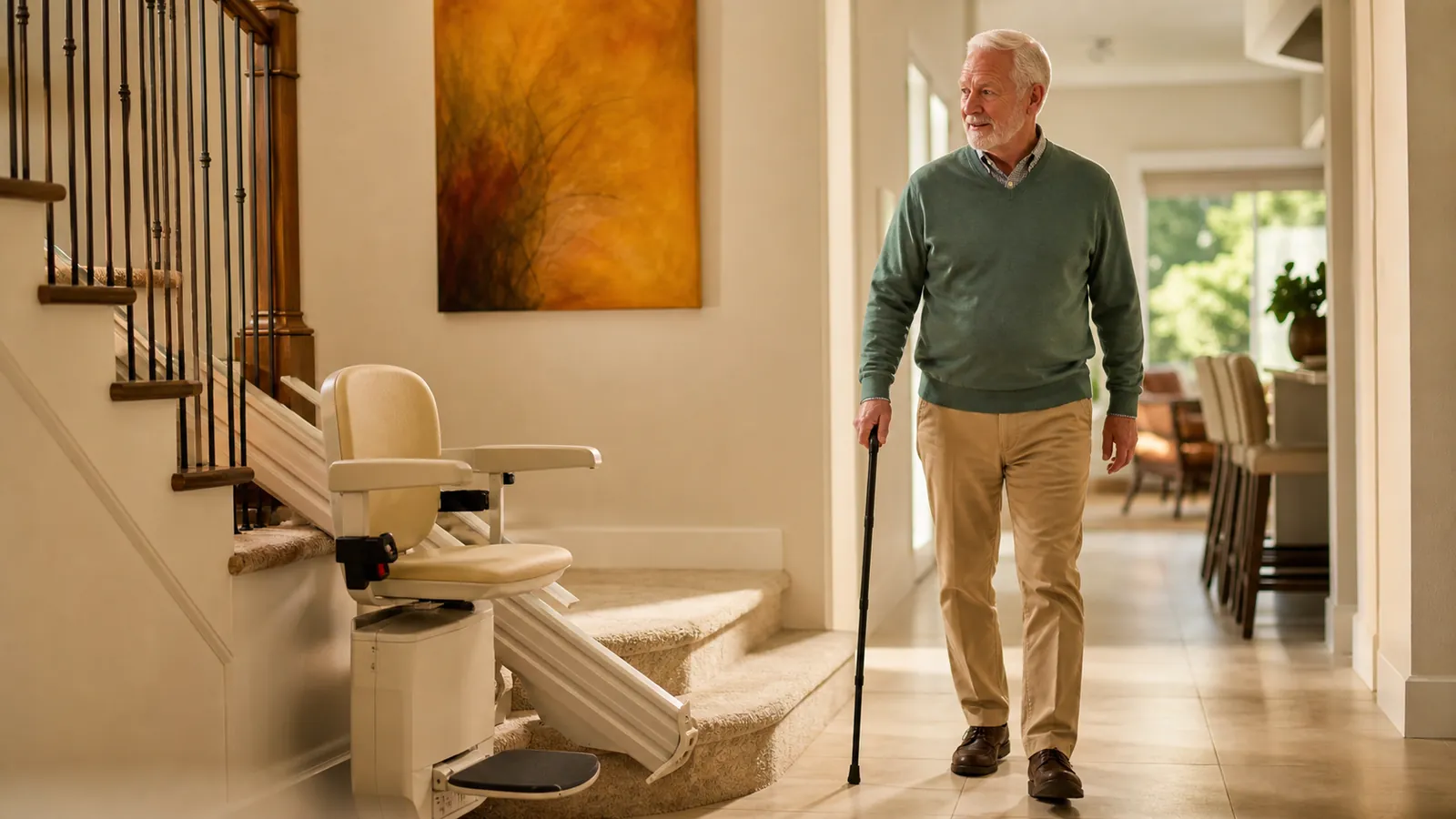
Stairs concentrate fall risk, so they get the strictest standard: secure handrails (ideally on both sides), light switches at both the top and bottom, nothing stored on the steps, and step edges your parent can actually see. Motion-activated plug-in lights are an inexpensive upgrade for stairwells and long halls. Encourage a house rule everyone can live with: one hand for the rail, and never carry anything that blocks the view of the steps. If stairs remain a barrier despite these changes and a clinician or occupational therapist confirms the access need, our guide to stair lift costs and planning questions covers that separate decision — alternatives, fit, and pricing included.
Living areas and floors
Living rooms fail in two places: underfoot, and at the height of the chair your parent rises from. Keep walking paths clear and wide enough to use naturally. Secure or remove throw rugs and runners — with your parent's consent, especially for pieces that carry meaning — and route cords along walls. Look at the furniture the way a tired person does: are the chairs and sofa a height they can rise from easily, and is anything they habitually grab for support actually stable?
The bedroom and the nighttime route
For nighttime falls, the bed-to-bathroom route deserves more attention than any other path in the home. A lamp reachable from bed, night lights the whole way, a completely clear floor, and a phone or help button within reach from the bed cover most of it. Stable, nonslip footwear by the bed beats loose slippers or socks for the half-awake walk.
The bathroom
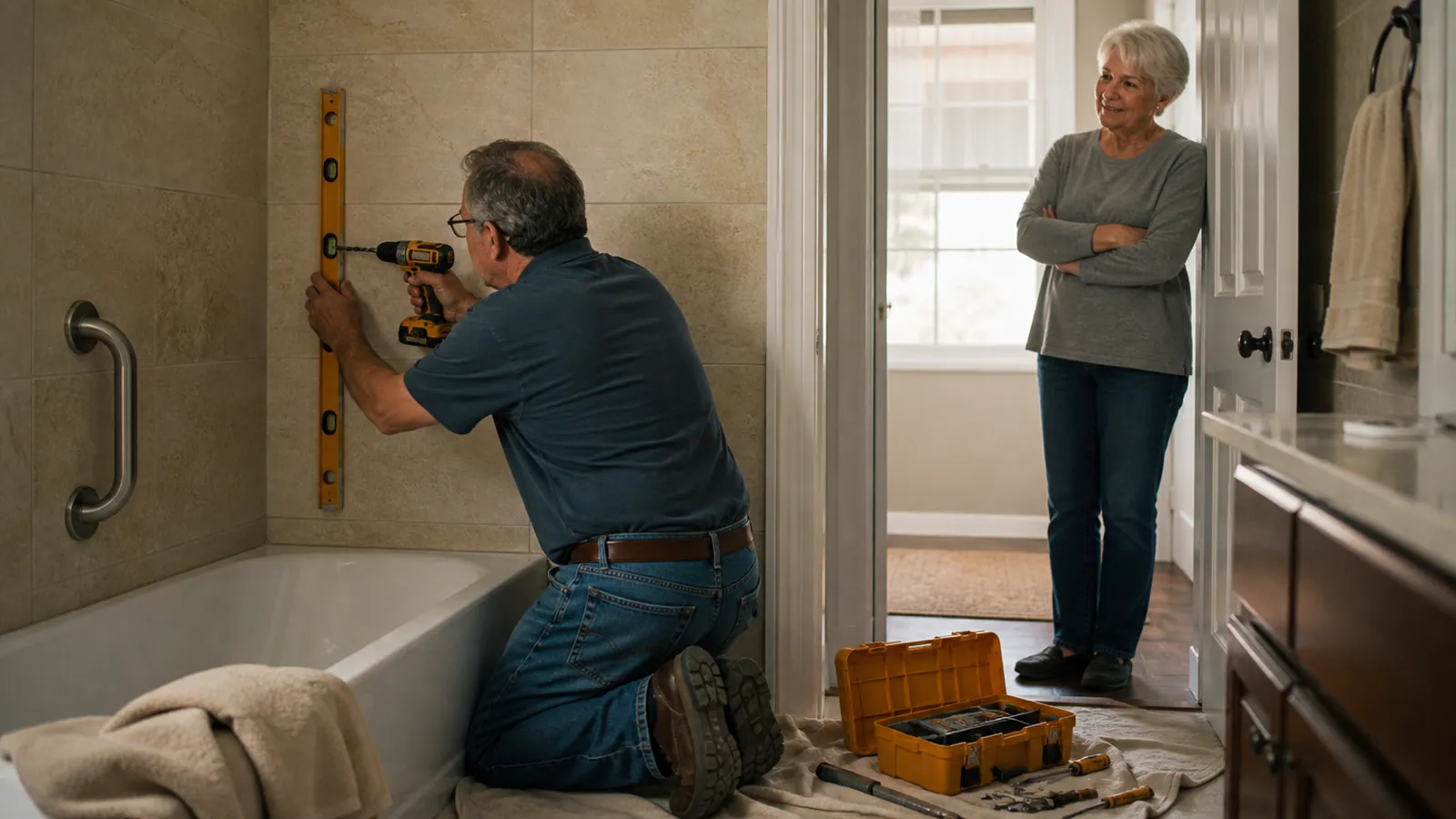
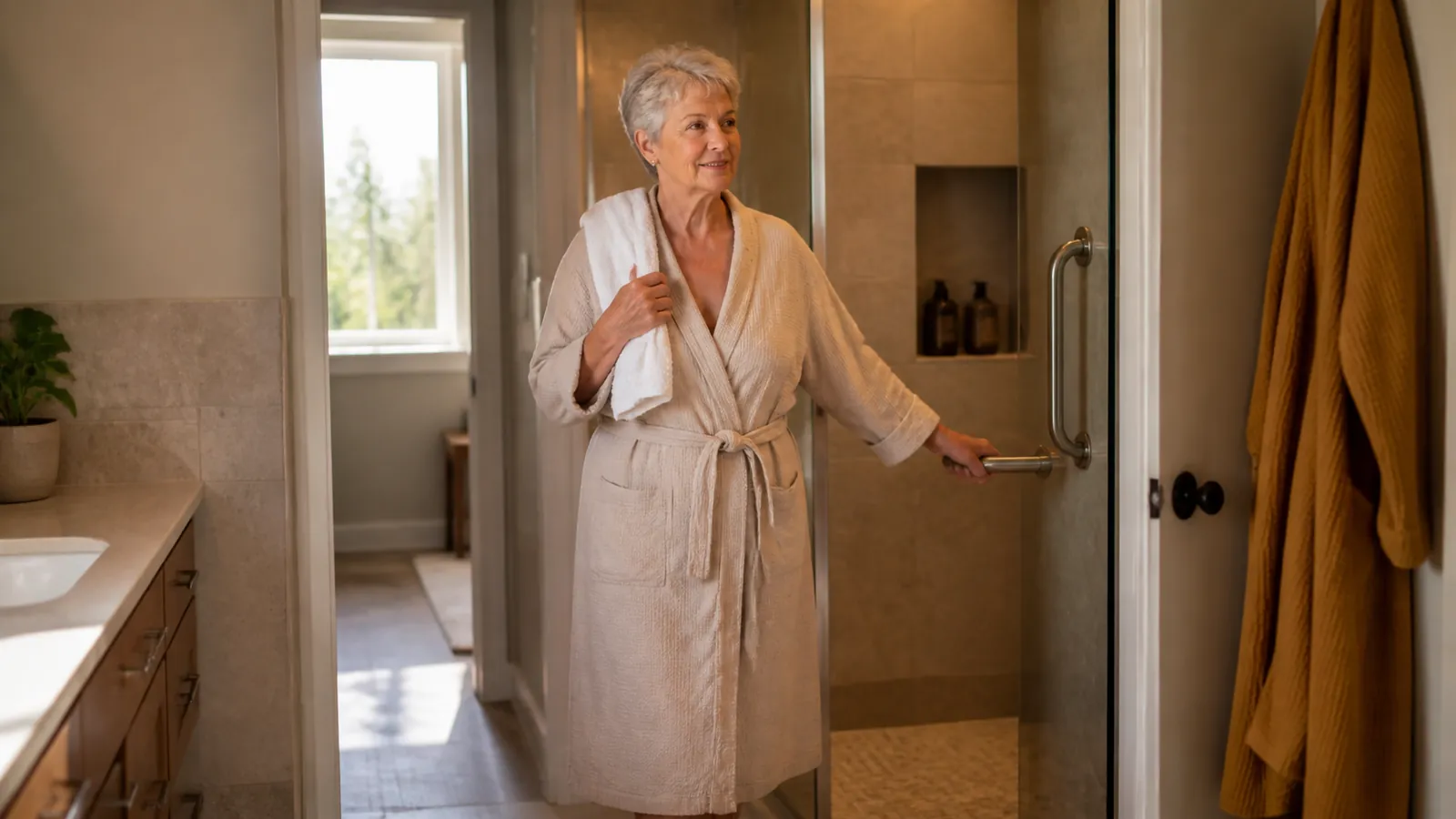
Almost everything hard about a bathroom happens in the two or three seconds of stepping into the tub and standing up again. Address lighting, nonslip surfaces in and around the tub or shower, and secure support for the movements that are hardest — stepping in and out, and sitting down and standing up. A grab bar is not a fall-prevention device on its own; it gives a secure handhold at exactly those moments, which is a narrower claim and a more useful one. Anything meant to bear weight, such as a grab bar, must be installed by someone qualified to anchor it properly; a towel bar pressed into service is a hazard wearing a disguise. If bathing access is still unsafe after the lower-cost fixes and an occupational therapist or clinician confirms the need, see walk-in tub costs and alternatives before requesting any quotes.
Kitchen, laundry, and everyday habits
Watch for the shelf your parent has quietly stopped reaching for; that is usually the kitchen's real hazard. Move the items your parent uses daily to shelves between waist and shoulder height, so routine cooking never requires climbing; where reaching up is unavoidable, a steady step stool with a bar to hold — never a chair — is the tool. Wipe spills immediately, and keep laundry loads small enough to see over. Three habits then carry across every room: pets underfoot are most dangerous at night and at feeding time, so consider a collar bell and keep toys and leashes off walking paths; shoes with support and nonslip soles, worn in the house and not just outside, quietly remove a risk factor; and carrying less is its own safety measure, because a load in both hands means no hand for the rail.
What should you do after an older parent falls?
A fall is frightening for both of you. A calm, conservative sequence protects your parent and keeps you from having to improvise under stress.
Call 911 for serious or uncertain injury
The emergency signs at the top of this guide govern here: when any of them is present — or you simply cannot tell how hurt your parent is — call 911 rather than watching and waiting. Do not spend those first minutes trying to figure out why the fall happened; cause comes later, and guessing at it can delay care.
Do not attempt an unsafe lift
If a head, neck, or back injury is possible, or your parent is in significant pain, keep them still and wait for emergency responders. The Red Cross puts the same rule more plainly: leave the person in the position you found them unless staying there is itself dangerous. Do not pull them up — an unsafe lift can worsen an injury and hurt you too. If they are clearly uninjured, let them get up slowly, their way, with you steadying rather than hoisting.
Watch for what shows up later
Two things are easy to miss in the relief after a fall that looked minor. The first is timing: Red Cross first-aid guidance is that head-injury symptoms do not always appear immediately, so a change in behavior, vomiting, a persistent headache, a change in vision, or becoming unresponsive means calling 911 even hours after the fall. The second is medication: the same guidance advises against giving painkillers for the headache, because they can mask the signs of a serious head injury. If your parent is uncomfortable, that is a reason to call their clinician, not to reach for the cabinet.
Report and document the fall
Every fall gets reported to your parent's clinician — the CDC's caregiver guidance asks families to report falls even when there is no obvious injury, and the earlier rule stands: any hit to the head means prompt medical contact. Then write down the observable facts while they're fresh, using the fall-notes block in the one-page fall-prevention plan below. Keep the notes factual, store and share them only as needed for care, and remember they are an aid to a professional review — not a diagnostic tool.
If what you are seeing goes beyond a fall — injuries that don't match the explanation, money that has gone missing, or a parent who can no longer keep themselves safe at home — there is a separate route. Adult Protective Services in the state where your parent lives receives those reports, and the Long-Term Care Ombudsman handles concerns about someone living in a licensed facility; both are reachable through the Eldercare Locator.
Update the prevention and response plans
Within a few days, re-walk the route where the fall happened, revisit the assessment signals above, and test whether the way your parent summons help actually worked. Fold what you learn into the 24-hour, 7-day, and 30-day plan below so the fall changes the plan instead of just the mood.
How should a family prepare in case a fall happens?
Prevention lowers risk; it cannot take it to zero. A response layer answers one question in advance: if your parent fell while alone, how quickly would anyone know? One boundary keeps this layer honest: a medical alert system is a response tool — it can help summon assistance after a fall, but it does not address the risk factors that cause falls. Build the plan with your parent's consent and around their actual habits; a plan built on wishful phone-carrying is a plan on paper only.
Choose a primary and backup way to call for help
Start with how your parent really behaves. If the phone genuinely travels with them, a phone-based plan can work; the NIA's home-safety guidance emphasizes keeping a phone within reach where you spend time, including near the bed and floor-reachable spots in main rooms. If the phone lives on a charger, a wearable alert or a fixed daily check-in call may fit better. Automatic fall detection — a sensor feature that tries to recognize a fall and call for help without the wearer pressing anything — is a feature with real limits, not a guarantee, and how those limits are disclosed varies by vendor. Whatever the primary method, name a backup — a scheduled check-in, a neighbor's knock — so one dead battery doesn't undo the plan.
Plan who responds and how they get in
Decide who gets called first and who is the fallback, and solve the door in advance: a trusted neighbor with a key, a building manager's procedure, or a lockbox where local emergency services support its use — verify the local policy rather than assuming. Note pets a responder should expect, and keep an up-to-date sheet of medicines, conditions, and emergency contacts where a responder could find it.
Test the plan
Pick a recurring, agreed date — a birthday month, the start of each season — to test the call method, confirm contacts still work, and update anything that changed. A regular rhythm your parent chose beats surveillance they didn't; there is no clinically required interval, just the habit of checking.
If you live far away
Distance doesn't change what needs doing; it changes who can see it and who can get there, so the adjustments are about people rather than equipment. Name a local primary and a local backup — a neighbor, a nearby friend, a building manager — with your parent's agreement about what each person may be told and when. Route program and service questions through your parent's county rather than your own, because eligibility and availability follow where they live. And when coordination is genuinely beyond what visits and phone calls can carry, a geriatric care manager is the professional who does this work locally on a family's behalf; ask what they charge, what they will and won't handle, and whether they have any financial relationship with the providers they recommend.
When family members disagree
Disagreement among siblings is close to universal here, and it usually surfaces as an argument about equipment when it is really an argument about something else. A few things help. Name each open item with an owner and a date out loud, because proximity is not consent and the sibling who lives nearest has not automatically agreed to own everything. Where the disagreement is about care level, remember that while your parent has capacity their stated preference governs — which turns an argument between siblings into a question to ask your parent directly. And where the real dispute is about money, inheritance, or who holds authority rather than about safety, that is elder-law and mediation territory, not a fall-prevention decision; keep the two conversations separate so the safety work can proceed. If the load has already landed unevenly, our guide to caregiver burnout and support options covers what to do before it breaks something.
If working through this section reveals a genuine gap — your parent lives alone and has no reliable way to summon help — that is the moment, and the reason, to compare medical alert systems on our current comparison page, where prices, contracts, and features are tracked because they change often.
What can family change, and what needs professional help?
The plan works when every item has an owner. This table converts the most common observations into ownership, so nothing waits on the wrong person.
| What you've noticed | Who usually owns it | Next step | Urgency |
|---|---|---|---|
| Hazards you can see: clutter, rugs, cords, dim lights, hard-to-reach items | Family and household — can usually start now, with your parent's agreement | Fix, then note it on the checklist with a recheck date | This week |
| A fall, near-falls, dizziness, vision or foot concerns, or any medicine question | Clinician or pharmacist | Book the review; bring the medicine list and fall notes | Soon — days, not months |
| Walking, balance, strength, or "which exercise is safe?" | Physical therapist, via clinician referral where required | Individualized assessment before any new routine | With the clinical review |
| Daily tasks, transfers, or how the home fits how your parent lives | Occupational therapist or home assessment | Ask the clinician or local aging services about access | As recommended |
| Getting information from your parent's providers | Your parent, with the family | Ask the practice what it needs on file, and have your parent say at the next visit that they want you included | Before the review |
| Anything that bears weight or touches structure, wiring, or plumbing | Qualified installer or licensed trade | Get it professionally assessed and installed — before buying equipment | Before purchase |
| Staying active with others | Evidence-based community program | Confirm local availability, fit, and accessibility | When cleared as appropriate |
For the local layer — occupational therapy access, home-assessment options, transportation, and classes — the Eldercare Locator (1-800-677-1116) is the official national path to your parent's Area Agency on Aging, and it's the parent's location that matters, not yours. Services vary by community, so ask what actually exists where they live.
What if the fixes cost more than you have
Money is a real constraint, and it does not have to stop the plan — because the highest-value items on this page cost nothing. Clearing the routes your parent actually walks, moving daily items within reach, agreeing on how they would call for help, reporting a fall to their clinician, and assembling the complete medicine list are all free, and together they cover most of what a first pass would recommend anyway.
For everything past that, ask before you buy. Area Agencies on Aging can tell you what home-modification help and community falls-prevention programs exist where your parent lives, and what each one costs — services and eligibility vary widely by community, so the only useful answer is a local one. Use the Eldercare Locator above, for your parent's county. If the larger question is how a family pays for care over time, our guide to how to pay for senior care covers the funding routes. And a professional assessment first is, in practice, the cheapest step available: it is how families avoid paying for the wrong thing.
What if nothing on this page fits
Sometimes the honest answer is that no option here matches the situation — the barrier is structural and unaffordable, the parent declines everything including the conversation, or the difficulty is really about memory, continence, or isolation rather than balance. That is not a failure of the plan; it means the question has outgrown this page. Two moves are usually right. Take the specific mismatch to the clinician or an occupational therapist, who can often name an option a family would not think of. And call the Eldercare Locator for your parent's county and describe the situation rather than asking for a service by name — local aging services exist precisely for the cases that do not sort neatly.
The one-page fall-prevention plan: what your family should write down
Most fall-prevention plans fail quietly, in the gap between a good conversation and the following Tuesday. Writing four things down closes most of that gap. The blanks below are yours to fill in — this is a worksheet, not a data table — so keep it on paper on the refrigerator or in one shared note, wherever the family will actually look, and bring the relevant parts to any appointment.
1. The route-by-route fix list
One row per route your parent actually uses. An item without an owner and a date is a wish. A filled-in row reads something like: Bed to bathroom · unlit hallway · two plug-in motion lights, agreed with Mom · Dana · Saturday · rechecked in 30 days.
| Route or area | What we noticed | Fix agreed with your parent | Owner | By when | Rechecked on |
|---|---|---|---|---|---|
| Entrance and outdoor path | |||||
| Stairs and hallways | |||||
| Living areas | |||||
| Bed to bathroom | |||||
| Bathroom | |||||
| Kitchen and laundry | |||||
| Needs professional installation |
2. The complete medicine list
Every prescription, every over-the-counter drug, and every supplement, with the dose and who prescribed it — or simply photograph the bottles. This is for the clinician or pharmacist to review; nothing on it changes without them.
3. Fall notes, written while they're fresh
For each fall or near-fall, capture: date and time; where it happened; what your parent was doing; the lighting; what they were wearing on their feet; how they felt before and after; whether their head made contact; any injuries; any recent medicine change; and how help arrived. Observations, not conclusions.
4. The response-plan card
The answers a responder or a worried sibling needs at 2 a.m. A filled-in card reads something like: pendant alarm · daily 8 a.m. call from Ray · Ray first, then Dana · key with Mrs. Alvarez in 4B, one indoor cat · sheet on the fridge door.
| Field | Your parent's answer |
|---|---|
| Primary way to call for help | |
| Backup method or check-in | |
| Who is called first | |
| Second contact | |
| How a responder gets in, and any pets they should expect | |
| Where the medicine and conditions sheet is kept | |
| Date we last tested this | |
| Next review date we agreed |
What should you do in the next 24 hours, 7 days, and 30 days?
These time buckets are our editorial planning suggestion, not a clinical schedule — and one thing never waits in a bucket: emergencies are now, not within 24 hours. Adjust the pace to your parent's preferences and their clinician's advice. The simplest fixes can happen the day your parent agrees; the realistic clock for the rest is set by the plan's slowest dependency, which is usually your parent's own readiness and decision timeline — a legitimate part of the process, not an obstacle — followed by appointment scheduling, quotes and installation, and start dates for local programs.
In the next 24 hours: safety and communication
Handle any emergency immediately. Clear the obvious hazards on the main routes, with your parent's OK. Ask them about the event or the worry that started this, and make sure a way to call for help is reachable from where they spend time. Write down your questions rather than trying to settle them now. The thing to watch for here is skipping the conversation and going straight to fixing — it is the fastest way to lose both cooperation and accuracy.
Within 7 days: assessment and information
Book the clinician or pharmacist review. Assemble the medicine list and the fall notes. Flag any vision, foot, or footwear concern, and look into what evidence-based classes run near your parent. The commonly dropped handoff at this stage is the report itself: families often complete everything on the list except telling the clinician that a fall happened.
Within 30 days: finish and recheck
Complete the agreed changes, including any professional installation. Start the activity or program that was chosen. Test the response plan end to end rather than assuming it works, and re-walk the highest-risk routes together. Watch for quiet stalls — an installation waiting on a quote, a referral nobody scheduled — and give every open item a name and a date. At the 30-day recheck, keep what worked, fix what stalled, and set the next review date while everyone's attention is still on it. After that, re-walk the routes whenever something changes — after any fall or near-fall, after a health, medicine, mobility, or routine change, after moving or rearranging the home — and at whatever regular family review your parent agrees to; many families tie it to seasons or holiday visits.
What fall-prevention mistakes should families avoid?
These patterns are common because they're understandable — each one is a reasonable instinct taken slightly too far. None of them causes a fall by itself, and noticing one in your own plan is progress, not failure.
| The shortcut | Why it falls short | The better next step |
|---|---|---|
| Treating one home fix as the whole plan | Most falls involve several interacting factors; the rug was never the only variable | Pair home changes with professional review and appropriate activity |
| Restricting activity out of fear | Less movement means less strength, which raises risk over time | Name the fear, and route it to assessment and supported activity |
| Adjusting medicines or supplements without professional advice | Interactions and side effects need professional eyes; the current final USPSTF falls recommendation makes no recommendation on vitamin D and a separate review is still open, so supplement questions — deficiency, bone health — belong with the clinician | Bring the complete list to a clinician or pharmacist and change nothing solo |
| Buying equipment before defining the problem | A cane, alert, tub, or lift bought before assessment often fits the worry, not the need | Define the need with the right professional first; then shop the specific solution |
| Letting the company that sells the product do the assessment | A free in-home "safety assessment" offered by a tub, lift, or stair-lift company is a sales visit; the person defining the problem is paid by the solution | Have the need defined by an occupational therapist or clinician, then invite quotes against that written definition |
| Assuming the sibling who lives closest has agreed to own this | Proximity is not consent, and the unspoken version of this arrangement is where family resentment usually starts | Assign each open item a name and a date at the 7-day checkpoint, out loud |
| Taking over without consent | It costs cooperation and accuracy — the two things the plan runs on | Return to shared observations and the smallest change your parent accepts |
If falls keep happening despite a genuine effort at this plan, and daily life is getting harder in other ways too, that's a broader conversation than fall prevention. Review the signs an older parent may need more help, and only when lower-intensity supports have truly been tried, the trade-offs of in-home care versus assisted living. One fall, by itself, is never a reason to change where your parent lives.
How do you choose fall-safety support at a glance?
Once the free and official steps are underway, this section maps situations to the type of support to consider — option types, not brands. Anything worth paying for is worth matching to a defined need first.
Comparing the option types
Every option type below carries the same fields, in the same order, and says plainly where a value is not something this page can publish. The first table covers what each option is and what it costs. The second covers what it does not do, how far the evidence goes, and what to confirm before you commit.
| Option type | Who provides it | Who is accountable | Cost basis |
|---|---|---|---|
| Household and routine changes | Your family, with your parent's agreement | Your family | Most first fixes free; small items are one-time retail |
| A conversation with your parent first | You and your parent | Both of you | Free |
| Professional assessment | Clinician, pharmacist, PT, OT, vision and foot care professionals | The clinician or therapist, within their scope | Billed as a medical visit rather than a purchase; Part B covers medically necessary outpatient therapy, and referral rules and billing vary by state and plan — see the Medicare section below |
| Evidence-based falls-prevention program | Community organizations running a tested program to a set protocol | The organization and its trained leaders | Varies by community and provider — ask the Area Agency on Aging what it charges |
| Response plan and monitored alert | Family for the plan; an equipment-plus-monitoring vendor for a monitored service | Family for the plan and contacts; the vendor for equipment and response | Equipment or activation fee, plus monthly monitoring, plus optional add-ons; return fees may apply — dated figures live on our comparison page, not here |
| Home modification requiring installation | Qualified installer or licensed trade, after an OT or clinician defines the need | The installer for the work; the professional who defined the need for the recommendation | Quoted per job — product plus installation; figures live on the walk-in tub and stair lift pages, not here |
| Option type | What it does not cover | Evidence status | Get in writing | Trigger to revisit |
|---|---|---|---|---|
| Household and routine changes | A risk assessment, and anything that bears weight | No claim to verify — a cleared hallway promises nothing | Who owns each fix, and by when | Any fall, near-fall, or change in routine or health |
| A conversation with your parent first | Nothing changes at home until something is agreed — that is the point | No claim to verify | What they said they would accept | Whenever the answer was "not yet" |
| Professional assessment | The home fixes themselves, and any guarantee your parent accepts the advice | Part B coverage of outpatient therapy verified below; referral rules, local availability, and out-of-pocket cost not verifiable from this page | Whether a referral is required, and what the practice needs on file for you to be included | A new fall, symptom, medicine, or mobility change |
| Evidence-based falls-prevention program | An individualized plan where symptoms, pain, or recent falls are involved — that is the PT's job | Program design verified through the federal directory; charges and availability not verifiable from this page | Fit, instructor qualification, and how symptoms are handled | A fall during the program, or a new limitation |
| Response plan and monitored alert | Fall prevention: it shortens the time to help and changes no risk factor | Medicare status verified — telephone alert systems denied, NCD 280.1 Version 4, effective June 9, 2025; vendor pricing, contract terms, and fall-detection performance not verifiable from this page | Itemized monthly total, contract length and cancellation terms, return fees, how fall-detection limits are disclosed | A change in where your parent spends time, a fall the device missed, or the agreed test |
| Home modification requiring installation | The reason the barrier exists; it replaces neither assessment nor activity | Medicare status verified — grab bars, stairway elevators, and bathtub lifts and seats denied, NCD 280.1 Version 4, effective June 9, 2025; quoted prices not verifiable from this page | Itemized quote plus a second quote, licensing and insurance, ruled-out alternatives, warranty and service terms | A change in mobility, or a modification your parent has stopped using |
Where a cell says a value varies or lives on another page, that is the honest status, not an omission: those numbers move, and a figure without its date and source is worse than no figure.
Read the evidence column as a map of where this page stops. Everything marked not verifiable here — what a program charges, what a contract says, how a manufacturer describes fall detection — is exactly what the "Get in writing" column exists to make you ask.
How much do fall-safety changes cost?
Cost sorts into four tiers, and only two of them resolve to a number you can look up for yourself.
| Tier | What's in it | How it is priced |
|---|---|---|
| No cost | Clearing the routes your parent walks, moving daily items within reach, agreeing how they call for help, reporting a fall, assembling the medicine list | Nothing to pay |
| Family-purchasable | Night lights, motion-activated plug-in lights, nonslip mats, a step stool with a bar, supportive footwear, a reachable bedside lamp | One-time retail purchase you can price yourself in an afternoon |
| Quote required | Grab bars and anything else that bears weight, step and handrail repair, stair lifts, walk-in tubs, and any electrical or plumbing work | Priced per job — product plus installation, quoted after the need is defined |
| Billed as care | A clinician, pharmacist, physical therapy, or occupational therapy visit, including a home assessment done by an OT | Billed as a medical visit rather than a purchase; what your parent owes depends on their coverage — see what Medicare Part B pays below, and ask the practice |
We do not publish a dollar figure for the third tier here. A cost figure on this site has to carry its unit, the year it was collected, a direct source, and the date we checked it, and a national average for an installed modification cannot meet that standard in a way that would help you — the number is set by your parent's house and your local market. Two routes get you a real figure this week: our stair lift costs and walk-in tub costs pages for what drives the price and which questions to ask, and two itemized local quotes written against a defined need. This tiering deliberately excludes recurring costs, such as a monitoring subscription.
Matching your situation to a next step
| Your parent's situation | Next step, and what to shortlist | The one question to ask first |
|---|---|---|
| Lives independently; no falls or new symptoms; hazards you can see | Walkthrough plus household changes with their agreement — nothing to shortlist yet | Which change would your parent actually accept? |
| A fall, near-falls, new unsteadiness or dizziness, or a new medicine | A professional assessment first — clinician or pharmacist, with PT or OT as advised — before comparing any product | Is a referral required, and what should we bring? |
| Lives alone and couldn't reliably call for help today | Build the response plan, then shortlist equipment-plus-monitoring vendors via compare medical alert systems | What is the itemized monthly total, including everything? |
| A confirmed bathing or stair barrier, verified by an OT or clinician | Shortlist qualified installers through walk-in tub costs or stair lift costs, alternatives included | Which lower-cost alternatives were ruled out, and why? |
That first question is a filter, not the whole diligence list. Before you sign or pay for anything, work the full "Get in writing" column in the option tables above — it differs by option type for a reason. And run every shortlisted item through the same columns as your route-by-route fix list: the specific risk it addresses, who owns it, the target date, and when you'll recheck that it's working.
What does Medicare cover for fall-safety equipment?
Short answer: less than most families expect, and the gap between what people assume and what the rules say is where money gets wasted. Original Medicare covers durable medical equipment — items that serve a medical purpose and are appropriate for use at home — and it excludes most of what a fall-prevention walkthrough turns up, on the grounds that safety and convenience items are not primarily medical in nature.
The tables below are drawn from Medicare's own Durable Medical Equipment Reference List, national coverage determination 280.1, Version 4, effective June 9, 2025 and checked August 1, 2026. This is a national determination, which matters more than it sounds: it applies in every state, so an item denied for a parent in Ohio is denied for a parent in Arizona. The reasons below are the ones the determination itself gives.
What Original Medicare denies, and the reason it gives
| Item | Original Medicare status | The reason given | What to do instead |
|---|---|---|---|
| Grab bars | Denied | Self-help device; not primarily medical in nature | Price installation locally; ask the Area Agency on Aging what home-modification help exists in your parent's county |
| Telephone alert systems | Denied | Emergency communications systems that do not serve a diagnostic or therapeutic purpose | Budget the full monthly cost yourself; see our comparison page for what to confirm |
| Stairway elevators, including stair lifts | Denied | Treated as elevators — a convenience item, not primarily medical | Get two itemized quotes after an OT or clinician defines the access need |
| Bathtub lifts | Denied | Convenience item; not primarily medical in nature | Ask an OT whether a lower-cost approach solves the same transfer problem |
| Bathtub seats | Denied | Comfort or convenience item; hygienic equipment | Same — the transfer problem, not the fixture, is the thing to define |
| Raised toilet seats | Denied | Convenience item; hygienic equipment; not primarily medical | Family purchase, usually inexpensive |
| Exercise equipment, including treadmills and parallel bars | Denied | Not primarily medical in nature; parallel bars are treated additionally as institutional equipment that a walker replaces at home | Use an evidence-based community program or a PT-designed plan instead |
What Original Medicare covers, and on what condition
| Item | Original Medicare status | The condition given | What to do next |
|---|---|---|---|
| Canes, quad-canes, walkers, and safety rollers | Covered when clinical criteria are met | Mobility assistive equipment, when the person meets the criteria in the determination | Ask the clinician about a PT assessment for selection, fitting, and training |
| Wheelchairs, manual and powered | Covered when clinical criteria are met | Mobility assistive equipment, when the person meets the criteria | Same route — the assessment comes before the equipment |
| Commodes | Covered if confined to bed or room | Coverage turns on confinement, not on bathroom accessibility | Confirm with the prescribing clinician how the criterion is documented |
| Patient lifts | Covered when the person's condition warrants it | Periodic movement needed to improve or arrest deterioration | Ask whether the clinical documentation supports it |
| Trapeze bars | Covered if bed confined and needed to sit up or change position | Medical need tied to confinement | Ask the clinician |
Two things these tables do not settle. Medicaid, state home and community-based services (HCBS) waiver programs, and local home-modification funds are separate systems with their own rules that vary by state — ask the Area Agency on Aging in your parent's county. And a denial under this list is not a statement that the item is useless; grab bars are one of the most sensible purchases in this whole guide. It only means Medicare will not pay for it.
Does Medicare pay for the physical or occupational therapy this guide recommends?
Usually yes, and this is the thing families most often get backwards after reading a coverage table. Therapy is a service, not equipment, so none of the rules above apply to it. Medicare Part B helps pay for medically necessary outpatient physical therapy, and separately for medically necessary outpatient occupational therapy, when a doctor or other qualifying provider certifies that your parent needs it.
Two details matter for fall prevention specifically. Coverage is not limited to recovery after an injury or surgery — Medicare's own description of the benefit includes therapy to improve or maintain current function, or to slow a rate of decline, which is the situation most families reading this page are actually in. And there is no annual ceiling: Medicare states there is no limit on what it pays for medically necessary outpatient therapy in a calendar year. Your parent pays the Part B deductible and then a share of the Medicare-approved amount; those figures change annually, so confirm the current ones with the practice or through Medicare's own help channels before the first visit.
How Medicare Advantage is different
Medicare Advantage is a different question, and this is where families and published advice most often talk past each other. Medicare's own guidance is that Medicare Advantage, Medicare Cost, and PACE plans may cover extra benefits that Original Medicare does not. Some plans have offered benefits in this territory, often limited to members with particular conditions, and what is offered differs by plan and by county and can change from year to year — which is why a general answer is worth very little here. Check your parent's own plan documents. The benefit, if it exists, will be named in the Evidence of Coverage, and Medicare's official help channels — 1-800-MEDICARE and the free State Health Insurance Assistance Program counselling it links to — will walk through a specific plan with you at no cost. Get any answer in writing before you buy on the strength of it.
Frequently asked questions about fall prevention
Are falls a normal part of aging?
No. Fall risk rises with age, but falls are not inevitable — most involve a combination of contributing factors, and many of those factors, from strength and balance to medicines and lighting, can be addressed. Treat any fall as a signal to review and adjust the plan, not as something to accept.
Should my parent use a cane or walker?
Maybe — but which device, and how it's fitted, is an individual call, not an article's. A mobility aid helps when it matches your parent's needs, height, and walking pattern, and when they've been taught to use it. Ask their clinician about a physical therapy assessment for selection, fitting, and training before buying anything.
Is tai chi good for preventing falls?
It can be a reasonable choice: the evidence behind the current USPSTF recommendation includes tai chi-style, multi-directional movement among the varied programs studied. No single program fits everyone, though — check fit through the official evidence-based program directory and ask the clinician first if there have been recent falls or symptoms.
What if my parent refuses grab bars or other changes?
Start smaller. Lead with what you've both observed, ask what they would change, and land the single change they'll accept — momentum matters more than completeness. If concern keeps colliding with "I'm fine," the full framework in how to talk with an aging parent about help covers scripts, timing, and boundaries.
Which bathroom change should we make first?
Define the transfer problem before you choose the fixture. The hardest moments in a bathroom are stepping in and out of the tub or shower and sitting down and standing up again, and different difficulties point to different answers — a nonslip surface, a seat, a securely anchored grab bar, or a different bathing routine altogether. An occupational therapist can name which one your parent's actual movement calls for, and that visit is usually covered by Medicare Part B when a provider certifies the need. Buying the fixture first is how families end up owning equipment for a problem their parent did not have.
How much does a medical alert system really cost?
More than the advertised price, usually. The list price is not the total: plan for possible equipment or activation fees, the ongoing monthly monitoring subscription, add-ons such as fall detection, and return fees when service ends. Prices and contract terms change often, so use the dated figures on our compare medical alert systems page and confirm the full monthly total with any provider before you pay.
Will Medicare pay for grab bars or a medical alert system?
Not under Original Medicare. Both are denied by name in the durable medical equipment reference list — grab bars as a self-help device, alert systems as emergency communications equipment with no diagnostic or therapeutic purpose. Medicare Advantage plans work differently, and the coverage section above sets out the full list, how Advantage plans differ, and what Part B does pay for.
Your next step
This week, ask your parent to walk their most-used routes with you and to tell you what feels least steady — then fill in the route-by-route fix list above and give every agreed fix an owner and a date. Put the 7-day and 30-day checkpoints on the calendar now. Share the tasks so no one person becomes the entire safety system, and say out loud who has agreed to what. When the fall-specific work opens bigger questions about daily life at home, the aging-in-place checklist for an older parent is the next page to work through. And for anything medical — a fall, a symptom, a medicine, an exercise plan — talk with their doctor.
About this guide
Aging Parent HQ is an independent educational publisher. This page is general information for families. It is not medical, legal, or financial advice, and it is not a substitute for an assessment by your parent's own clinician or therapist. We are not a healthcare provider, a home-care agency, a senior-living placement service, or a law firm, and nothing here diagnoses a condition or scores anyone's risk.
Review status: this page has been checked against the federal and professional sources listed below, and it has not yet had independent clinical review. The review it needs is by a clinician, physical therapist, or occupational therapist who works with older adults; until that happens, read the clinical framing here as a sourced summary of federal and professional guidance rather than as reviewed practice advice. When the review is complete, the reviewer, their credentials, and the date will be named here.
How this page is maintained: every figure, program rule, and coverage statement is checked against its primary source, and the date of the most recent check appears below. Volatile items — federal coverage rules, the CDC's falls guidance, the USPSTF recommendation, and any linked cost figure — are rechecked at each review. Every federal link on this page is also checked quarterly, because agency sites reorganise more often than guidance changes; where a linked document moves, the phone numbers and program names in the text are enough to find it. Next scheduled review: February 2027, and sooner if any of those sources changes. If you find an error or an out-of-date figure on this page, email hello@agingparenthq.com; we will check it against the source and post a dated correction.
Sources and last verified date
- Facts About Falls — Centers for Disease Control and Prevention — Fall prevalence and reporting rates among adults 65+, repeat-fall context, the share of falls resulting in a treated or activity-limiting injury, modifiable risk factors including vitamin D deficiency, multifactorial causation, head-impact and blood-thinner caution, and the fear-inactivity cycle (page reviewed January 27, 2026; checked August 1, 2026). Data years for the two injury figures come from the page's own references: the 37% share of people who fall is drawn from an MMWR analysis of United States data for 2012–2018, and the one-in-ten share of falls from a 2021 review of older-adult fall risk factors. CDC publishes the one-in-four prevalence figure and the under-half reporting figure in the page summary without an attached reference, so the page review date is the most precise date available for them.
- Older Adult Fall Prevention (STEADI) — Centers for Disease Control and Prevention — The CDC screening, assessment, and intervention initiative underpinning this guide's methodology note.
- Preventing Falls and Hip Fractures — Centers for Disease Control and Prevention — General prevention actions: medication review, vision care, strength and balance activity, footwear, and home safety.
- Family Caregivers: Protect Your Loved Ones from Falling (PDF) — CDC STEADI — Caregiver prompts to report falls and unsteadiness and to bring a complete medicine list to reviews (2018 brochure; URL confirmed live August 1, 2026).
- Check for Safety: A Home Fall Prevention Checklist for Older Adults (PDF) — CDC STEADI — Room-by-room hazard structure (2017 brochure, still linked from current CDC resources; used for hazards, not technical specifications).
- Postural Hypotension: What It Is and How to Manage It (PDF) — CDC STEADI — Lightheadedness on standing as a clinician-review trigger (listed among CDC's current STEADI patient resources as of August 1, 2026).
- Vitamin D, Calcium, or Combined Supplementation for the Primary Prevention of Falls and Fractures in Community-Dwelling Adults: Draft Recommendation Statement — U.S. Preventive Services Task Force — Draft, not final: the December 17, 2024 conclusion that vitamin D supplementation, with or without calcium, has no net benefit for preventing falls or fractures in community-dwelling postmenopausal women and men 60 or older (checked August 1, 2026).
- Vitamin D, Calcium, or Combined Supplementation for the Primary Prevention of Falls and Fractures in Community-Dwelling Adults: topic status — U.S. Preventive Services Task Force — Official confirmation that the update remains in progress with public comment closed, and that the 2018 statement is still the current final recommendation on this topic (checked August 1, 2026).
- Falls Prevention in Community-Dwelling Older Adults: Interventions — U.S. Preventive Services Task Force — June 2024 final recommendation: exercise interventions for community-dwelling adults 65+ at increased fall risk; individualized multifactorial interventions; the components, frequency, duration, and format of the trials reviewed; and the withdrawal of the 2018 recommendation against vitamin D supplementation pending a separate review (checked August 1, 2026).
- Physical Activity Guidelines for Older Adults — Centers for Disease Control and Prevention — General context that older-adult activity spans aerobic, strength, and balance work adapted to ability and health.
- Evidence-Based Falls Prevention Programs — Administration for Community Living — Official directory of evidence-based community falls-prevention programs, and what "evidence-based" means: tested in research, translated into set protocols, delivered by trained leaders in community settings with fidelity tracked. Availability varies locally.
- Eldercare Locator — Administration for Community Living — Official national path (1-800-677-1116) to Area Agencies on Aging and local services.
- What If I Suspect Abuse, Neglect, or Exploitation? — Administration for Community Living — Official routing to Adult Protective Services in the state where the older adult lives, and to the Long-Term Care Ombudsman for concerns in a licensed facility.
- Head Injury — First Aid — MedlinePlus / A.D.A.M. Medical Encyclopedia, U.S. National Library of Medicine (licensed content) — General first-aid reference, not emergency instruction: keeping a person with a suspected spine injury still and not moving them.
- When to Use the Emergency Room — Adult — MedlinePlus / A.D.A.M. Medical Encyclopedia, U.S. National Library of Medicine (licensed content) — General first-aid reference, not emergency instruction: emergency warning signs supporting the call-911 guidance; the article treats the list as examples, not exhaustive.
- Head, Neck, and Spinal Injury — American Red Cross — Signs requiring immediate emergency treatment after a fall, the rule to leave a person in the position found, the fact that head-injury symptoms may not appear immediately, and the caution against painkillers that can mask them. Guidance developed with the Red Cross Scientific Advisory Council (checked August 1, 2026).
- Preventing Falls at Home: Room by Room — National Institute on Aging — Federal cross-check for room-by-room safety and keeping a phone reachable as part of emergency-communication planning.
- Advance Care Planning: Advance Directives for Health Care — National Institute on Aging — What a durable power of attorney for health care is, and that a health care proxy acts when the person cannot communicate decisions themselves (page reviewed January 23, 2026).
- Does HIPAA Permit a Doctor to Discuss a Patient's Health Status With the Patient's Family and Friends? — U.S. Department of Health and Human Services, Office for Civil Rights — When a provider may share information with a family member involved in a patient's care, under 45 CFR 164.510(b), and that the rule permits rather than requires disclosure.
- Durable Medical Equipment Reference List, NCD 280.1 — Centers for Medicare & Medicaid Services — Official Original Medicare coverage status and stated reason for each item in the coverage table: grab bars, telephone alert systems, stairway elevators, bathtub lifts and seats, raised toilet seats and exercise equipment denied; canes, walkers, safety rollers, wheelchairs, commodes, patient lifts and trapeze bars covered under stated conditions (Version 4, effective June 9, 2025; record checked August 1, 2026).
- What's Not Covered by Part A and Part B — Medicare.gov, Centers for Medicare & Medicaid Services — Official statement that Medicare Advantage, Medicare Cost, and PACE plans may cover extra benefits Original Medicare does not (checked August 1, 2026).
- Physical Therapy Services — Medicare.gov, Centers for Medicare & Medicaid Services — Official Part B coverage of medically necessary outpatient physical therapy: the certification requirement, the deductible-plus-coinsurance structure, the absence of an annual payment limit, and that coverage extends to improving or maintaining current function or slowing a rate of decline (checked August 1, 2026).
- Occupational Therapy Services — Medicare.gov, Centers for Medicare & Medicaid Services — Official Part B coverage of medically necessary outpatient occupational therapy when a provider certifies the need (checked August 1, 2026).
- Contact Medicare — Medicare.gov, Centers for Medicare & Medicaid Services — Official no-cost help channels for checking a specific plan's benefits: 1-800-MEDICARE and the State Health Insurance Assistance Programs (checked August 1, 2026).
Last verified: August 1, 2026
Next review: February 2027
Not sure what fits your situation?
Answer a few questions and get a shortlist matched to where you are right now.
Take the 2-minute questionnaireKeep reading
 How to Talk to Aging Parents About HelpUse a respectful, step-by-step plan to talk with an aging parent about help, handle refusal or anger, and agree on the smallest safe next step.
 Power of Attorney for an Aging Parent: Key StepsLearn when an aging parent can create financial and medical powers of attorney, what varies by state, and how to make the documents usable.
 Aging in Place Checklist for an Older ParentUse this aging-in-place checklist to review home safety, daily needs, support options, and next steps that can help an older parent stay at home.
 Stair Lift Cost: Straight, Curved & Installed PricesSee current stair lift costs for straight and curved stairs, compare new, used and rental options, and normalize two itemized installation quotes.