
Stair Lift Cost: Straight, Curved & Installed Prices
Advertiser disclosure: Aging Parent HQ may earn a commission when you request a quote or sign up for a service through links on this site. It never costs you extra and never changes our recommendations — we suggest the smallest, cheapest change that solves the problem first, and plenty of what we recommend earns us nothing.
What a stair lift actually costs, and what that figure is not
If you are pricing a stair lift for your parent's home, here is the honest starting point: there is no single national price. What manufacturers publish gives you orientation. On Bruno's stair-lift pages (checked August 10, 2026), straight lifts usually start around $4,000 for base models and around $6,000 for premium models, while curved lifts generally start at $10,000+ and around $13,000 once the rail carries a base bend. On Stannah's U.S. price page (checked August 2, 2026), straight models start from $4,700 and curved from $10,800.
Those are vendor-specific published anchors — a planning baseline, not a price. Each covers a different product, scope, and sales channel, so they cannot honestly be blended into one "average stair lift cost." The only figure that binds anyone is a local itemized proposal for your parent's exact stairs.
The smallest useful first step costs nothing: confirm your parent actually wants a lift and can use one, write down the staircase facts (straight or turning, length, landings, width, nearby outlet), and then request two itemized quotes built on the same specification.
If your parent has just fallen and may be injured, cannot get up, or has new weakness, fainting, confusion, severe pain, or trouble breathing, call 911 or seek urgent medical care now. A stair-lift purchase is not the immediate next step. If you are not sure whether your parent can sit securely, transfer on and off the seat, operate the controls and footrest, swivel, and stand safely at the top landing, ask their clinician or an occupational therapist for an individualized assessment before you buy anything.
Where should your family start?
- Start with a conversation — and no purchase yet — if your parent has not said they want a lift or is unsure they would use one; a lift that sits unused helps no one, and the decision is theirs to share.
- Start with straight-rail quotes if the staircase is one straight flight, because a stock straight rail is the least complex and least expensive configuration.
- Plan on custom curved quotes if the stairs turn, curve, or include a mid-flight landing, and compare a curved proposal against a two-straight-lift proposal only if a mid-landing transfer would genuinely work for your parent.
- Consider a rental or certified refurbished straight lift if the need may be temporary or the budget is tight, judged on written total-cost terms rather than the monthly payment.
- Get a professional assessment first if transfer, seated balance, or the landing exit is uncertain — a showroom demonstration is not an individualized evaluation.
The rest of this page:
- What does a stair lift cost installed?
- What is included in the installed price?
- How do straight, outdoor, and curved scenarios compare?
- Should you buy new, buy refurbished, or rent?
- Will a stair lift work for your parent and your staircase?
- Who signs, who owns it, and what you need before you can act
- How do you compare two stair lift quotes?
- How do cash, rental, and financed totals compare?
- What will and will not help pay for a stair lift
- When is a stair lift not the right first step?
- How do you choose a stair lift path at a glance?
- Common questions about stair lift costs
- What to do next
- About this guide
- Sources and last verified date
What does a stair lift cost installed?
Price sources below were checked on the dates shown in each row and are scheduled for re-verification by September 10, 2026. All figures are set by the vendors, are subject to change, and are shown here exactly as published — by source, configuration, and scope.
One conflict is worth naming before you read the table. Stannah publishes two different starting-price sets on its own U.S. site. Its stair lift price page lists straight from $4,700, curved from $10,800, and outdoor from $6,300, while its stairlift guide says new straight prices usually start at $5,700, new curved at around $13,500, and new outdoor at $7,300 (both checked August 2, 2026). This page uses the price page, because that is the page the company maintains for pricing. But the gap is real, it reaches $2,700 on curved rails, and it is the clearest possible argument for treating any published "from" figure as an opening position rather than a quote.
Published figures elsewhere run lower still. NCOA's Bruno review puts the Elan straight at a $3,000 starting cost for the lift alone, and multi-brand dealers commonly advertise straight installations from around $3,500. This page uses each manufacturer's own current pricing page rather than third-party estimates or dealer advertising, which is why its anchors sit higher; where a manufacturer publishes nothing, this page says so rather than substituting someone else's number.
| Source (checked) | Configuration | Figure type | Published amount | Installation scope | Limitations |
|---|---|---|---|---|---|
| Bruno (Aug 10, 2026) | Straight, base models | Vendor starting price | Around $4,000 | Dealer's final quoted price generally includes lift, options, delivery, and installation; local dealers set installation pricing | Manufacturer/dealer figure, not a market average; options, permits, and site prep can add |
| Bruno (Aug 10, 2026) | Straight, premium models | Vendor starting price | Around $6,000 | Same as above | Same as above |
| Bruno (Aug 10, 2026) | Curved, most basic configurations | Vendor starting price | $10,000+ | Same as above | Custom rail; length, turns, and parking options raise the total |
| Bruno (Aug 10, 2026) | Curved with a base bend | Vendor starting price | Around $13,000 | Same as above | Same as above |
| Stannah (Aug 2, 2026) | Straight | Vendor starting price | From $4,700 | Stannah states its quote includes installation and agreed options | Its own guide page publishes a $5,700 starting figure instead; direct and distributor terms may differ |
| Stannah (Aug 2, 2026) | Straight, typical purchase | Vendor typical example | About $5,700; common option packages $5,700–$6,200 | Same as above | A typical example, not a promise for your staircase — and note this same $5,700 appears on Stannah's guide page as a starting figure |
| Stannah (Aug 2, 2026) | Curved | Vendor starting price | From $10,800 | Same as above | Its own guide page publishes around $13,500 instead; custom rail, configuration drives the final figure |
| Stannah (Aug 2, 2026) | Outdoor | Vendor starting price | From $6,300 | Same as above | Its own guide page publishes $7,300 instead; weather-rated equipment is a different scope than an indoor premium model |
| Acorn (Aug 10, 2026) | Straight, curved, outdoor | Not publicly stated on inspected pages | Quote required after a free home survey | Determined in the individual quote | No amount should be inferred; Acorn states what it quotes is what you pay and that the quote stays valid for up to 12 months — get that in writing |
These figures orient the conversation. Your binding number is a local itemized proposal for the same configuration and scope.
As you compare, keep five different numbers separate, because vendors and dealers use them interchangeably in conversation: the vendor starting price (the lowest published entry point for a configuration), a typical vendor example (what one company says its customers commonly pay), the installed cash total (everything on the final contract, paid once), the rental total over expected use (initial payment plus continuation months plus return costs), and the all-in financed total (down payment plus every scheduled payment and fee). A starting price is not the installed total, and no source reviewed for this page establishes a representative U.S. national average for identical installed scope — which is why this page shows source rows instead of inventing one.
What actually moves the number, according to the manufacturers' own cost factors: the staircase configuration (straight, landing, curved, spiral, outdoor), rail length and turns, lift capacity, the model tier, powered options, and installation scope including any permits or site preparation your state or home requires.
What is included in the installed price?
The gap between an advertised starting price and the final contract lives in the line items. Before you sign, every row below should be marked in the quote with one of six statuses — Included, Fixed price, Allowance, Unit price, Excluded, or Unknown. Call it the Six-Status Quote Marking, and use the same six words on every proposal you receive. No component carries a universal national dollar amount — Bruno notes there is no universal installation cost because local dealers set their own pricing — so the goal is a complete, itemized picture rather than a rule of thumb.
| Quote line | What to ask before signing |
|---|---|
| Home survey and measurement | Who measured, how, and who bears the cost of a measuring error or remeasure |
| Chair, carriage, and exact model | Manufacturer, model name, capacity, and whether it is new, refurbished, or rental stock |
| Rail | Straight stock rail or custom curved rail; length, turns, overrun, and parking position |
| Options | Power swivel, power footrest, folding or hinged rail, seat size, upholstery, remotes, key lock, outdoor cover — and which are required for safe use versus optional |
| Delivery | Included in the price or billed as freight |
| Installation labor | Included, and for how many hours or a fixed completion |
| Electrical and charging | Whether an outlet must be added or moved, and who prices that work |
| Site preparation and repairs | Any stair, surface, or weather-protection work, and who performs it |
| Permits and inspection | Whether your parent's state or locality requires a permit, who pulls it, and whose fee it is |
| Training and testing | A demonstrated acceptance test and user training before the installer leaves |
| Warranty and service plan | What is covered by component, labor, batteries, and travel — in writing, not as a slogan |
| Taxes and fees | Itemized, not folded into an "all-inclusive" label |
| Removal and end of use | Removal fee, return condition, and stair-surface repair when the lift is no longer needed |
| Written discounts | Any promotion in writing, with its expiration and eligibility conditions |
Two habits keep this honest. First, treat "all inclusive," "lifetime," and "starting at" as labels rather than scopes — each one needs the underlying fields above spelled out. Second, when a salesperson cannot mark a row, write Unknown rather than assuming Included; unknown fields are the most common source of change orders after the contract is signed.
There is one upsell worth knowing by name. A straight flight with a door or a tight landing at the top does not automatically require a custom curved rail — a hinged or folding rail option exists for exactly that problem, and Bruno lists it among standard straight-lift options. If a surveyor quotes curved on a staircase that runs straight up and down, ask on the spot what makes the straight-plus-hinge configuration unworkable here, and get the answer in the written quote.
Permits are the one line on that list set entirely locally. Some states and municipalities require a permit for a stair lift, some require only an electrical permit if an outlet has to be added, and some require neither — there is no national rule and no national fee. So handle it procedurally rather than by research: ask the installer to name the authority with jurisdiction over your parent's address, which is usually the municipal or county building department, say who pulls the permit, and put the fee in the quote as a fixed price or an allowance rather than a verbal estimate. If nobody at the company can name that authority, that is itself the answer for the Unknown column.
How do straight, outdoor, and curved scenarios compare?
Each row below is a source-labeled orientation, not a quote and not a national low/base/high distribution. The anchors come from the vendor table above and carry the same dates.
| Scenario | Source anchors | Assumes | What pushes it higher |
|---|---|---|---|
| A — Basic indoor straight staircase | Around $4,000 (Bruno straight base start, Aug 10, 2026) to $4,700 (Stannah straight start, Aug 2, 2026) | One straight flight, a stock rail cut to length, standard capacity, manual swivel and footrest, an existing outlet near the charging point, and no permit or site complication | A longer rail, powered options, a folding rail to clear a doorway, higher capacity, or any electrical work |
| B — Upgraded straight or outdoor straight | About $5,700–$6,200 (Stannah typical and optioned straight, Aug 2, 2026); around $6,000 (Bruno premium straight start, Aug 10, 2026); from $6,300 (Stannah outdoor start, Aug 2, 2026) | Either a comfort-and-capacity upgrade indoors or weather-rated equipment outdoors — different scopes even where the dollars overlap, since one buys comfort and powered options and the other buys weatherproofing and outdoor site work | Combining powered options with a long rail, or outdoor electrical and surface preparation |
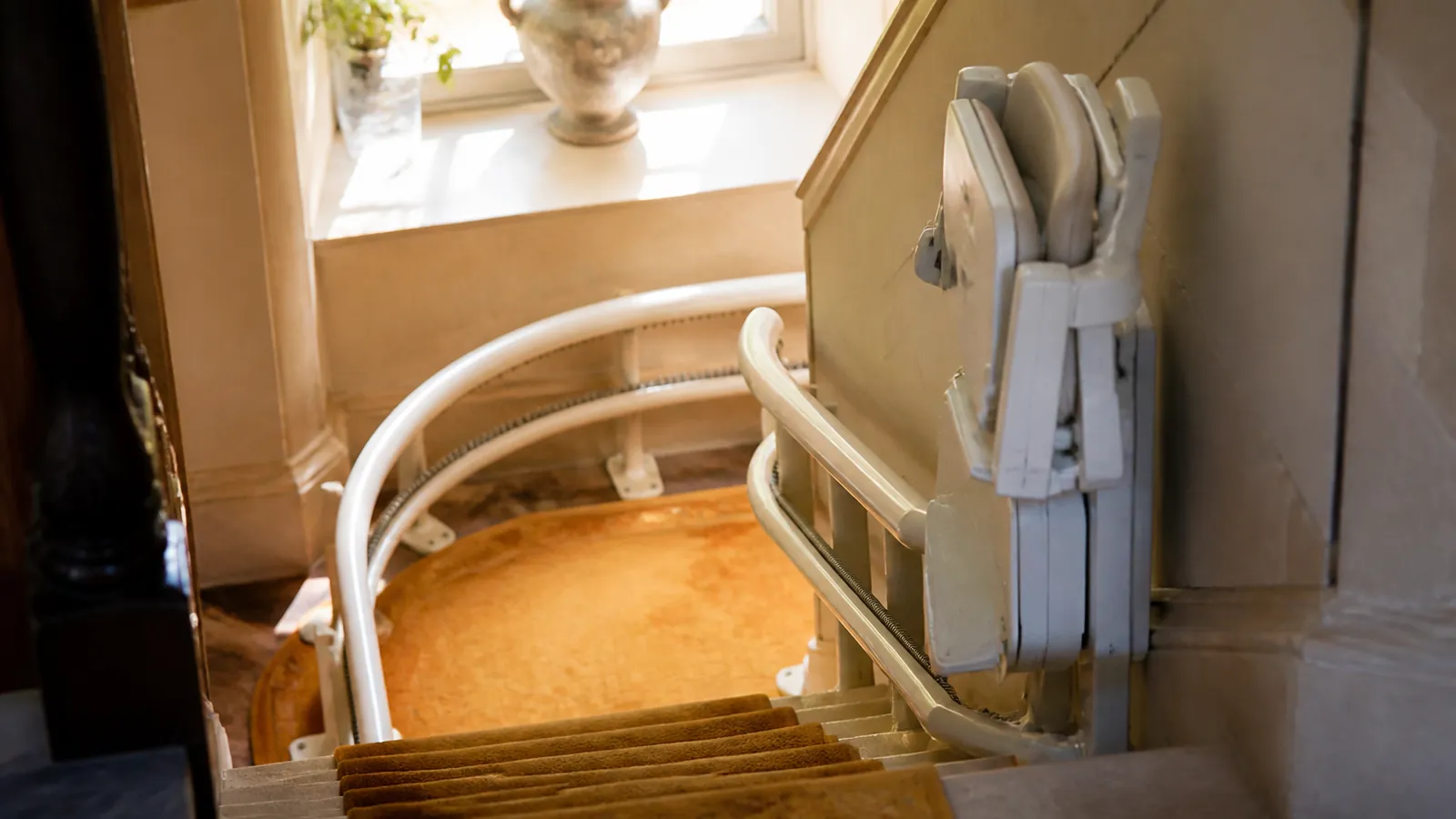
| C — Custom curved or multi-landing staircase | $10,000+ for basic curved configurations and around $13,000 with a base bend (Bruno, Aug 10, 2026); from $10,800 (Stannah curved start, Aug 2, 2026) | A handmade rail built to the exact staircase | The number of turns, total rail length, and the parking or overrun positions |
One note on scenario C, because it is a fit decision before it is a price decision. For a staircase with a mid-flight landing, Bruno's guidance is that a continuous curved ride is best practice, while two straight lifts may cost less but require your parent to stand, transfer, and re-seat mid-staircase. If the mid-landing transfer is not comfortably workable, the cheaper configuration is not the better one.
 Vendor price anchors checked August 2026
Should you buy new, buy refurbished, or rent?
The right ownership path depends mostly on expected duration of use, the staircase, and who stands behind the equipment afterward. Two of the four paths below are both "used," and the difference is the whole decision: a certified refurbished lift is inspected, restored, installed, and warranted by a manufacturer or authorized dealer, while a private used lift is a secondhand purchase from an individual, with fit, rail, installation, and support left entirely to you. Vendor terms below are named examples, not market-wide rules.
| Path | Cost basis | Fit and reusability | Warranty and service | Evidence confidence | Confirm before you pay |
|---|---|---|---|---|---|
| New purchase — full configuration choice from current models | One installed cash total on the contract, paid once. The equipment anchors above are the entry point; options, site work, permits, and taxes sit on top of them | Built or cut for the staircase; straight units are the most likely to be reusable later | Manufacturer terms — Bruno states limited lifetime coverage of primary components on indoor lifts, and 5-year limited coverage outdoors, for the original purchaser when installed by its dealer | Warranty structure verified from provider documentation, Aug 10, 2026; your installed total is quote-determined and not publicly stated by anyone | The exact written warranty by component, labor, and travel; the installed cash total by line |
| Certified refurbished — a used unit inspected and restored by a manufacturer or authorized dealer | A discounted purchase price, still one installed total. Stannah states its reconditioned lifts typically cost around 80% of new; applied to its own $5,700 typical straight purchase, that is roughly $4,600 before options and site work | Straight rails can be refurbished and refit; curved systems generally need a new custom rail | Shorter written warranty than new, with the vendor's own inspection process and stated reconditioned terms | The 80% ratio is Stannah's published statement, Aug 2, 2026; the $4,600 is our arithmetic from that ratio, not a Stannah quote | Model and serial, the refurbishment checklist, new batteries and parts, rail compatibility, installation, and the warranty — all in writing |
| Private used — a secondhand chair, often without the rest of the system | A unit price only. Installation, rail, missing parts, and any support are separate and unbundled, and no reviewed source publishes what they add. Asking prices on general marketplaces are seller-set and verify against nothing; if the appeal is the low price, weigh it against your parent's state AT reutilization program in the funding table below, where the equipment at least comes with a program behind it | High risk of rail mismatch and missing parts; curved rails are custom and rarely transfer | Usually none; Bruno cautions that marketplace units raise installation concerns and typically lack long-term manufacturer warranty | Not publicly stated by any reviewed source; every figure here is seller-specific and unverifiable in advance | An independent dealer fit assessment, installation, and support before any money changes hands |
| Rental / rent-to-own — use of a lift for a defined term without full purchase | Two components, always: an initial payment covering a defined initial term, then a continuation monthly rate afterward. In Stannah's program the initial payment covers a roughly six-month initial period plus installation, service, and removal in most of its direct states. No provider reviewed for this page publishes a monthly rate | Typically straight staircases from local stock; availability varies by provider and state | Per the written rental agreement, which is where service responsibility during the term is defined | Term structure verified from provider documentation, Jul 29, 2026; monthly rate not publicly disclosed — quote required; availability varies by state — confirm | Initial term and payment, what it includes, the continuation monthly rate, the purchase option and whether payments credit toward it, and return conditions |
One rental detail deserves emphasis because it changes the math: in Stannah's published example, continuing month to month after the initial period does not build credit toward purchase. Other providers structure this differently, which is exactly why rental is a term-and-service decision, not a monthly-payment decision — run the totals with the formulas later on this page before concluding that renting is cheaper.
Whichever path you take, three things should send you back to this comparison later: a change in how long your parent expects to need a rental, a change in how your parent transfers, or another household member starting to need the stairs differently.
Will a stair lift work for your parent and your staircase?
A stair lift only earns its cost if your parent will actually use it, comfortably and routinely. Work through these questions before any sales visit — they are decision rules, not a clinical screening, and none of them can be answered by age alone.
Does your parent want it, and will they use it?
Does your parent want the lift, or are they agreeing to end the conversation? Will they wait for it rather than walking beside it, park it at the charging point, and use it at night? If they are hesitant, a small reversible step often works better than a purchase — it can help to talk with your parent about a small trial before committing to hardware.
Can they get on and off safely?
The ride is rarely the hard part; getting on and off is. Look at seat height, whether a manual or powered swivel suits their strength and dexterity, standing space and a solid handhold at the top and bottom, exposure at the top step, and whether they can manage the footrest. Rated capacity belongs in this conversation too, not only in the price conversation: Bruno rates its Elan straight lift at 300 lb and its Elite indoor and outdoor models at 400 lb, and says stair lifts in North America run from 300 to 600 lb (Aug 10, 2026), so ask for the rated capacity of the exact model quoted, in writing. If any of this is uncertain, ask a clinician or occupational therapist for an individualized assessment — the CDC's STEADI initiative describes how clinicians screen and assess fall risk and intervene, and that professional lens is more reliable than a showroom demonstration.
Can the rest of the household still use the stairs?
Measure the folded width and check that other household members, pets, and grandchildren can still pass safely; check whether the rail end blocks a doorway or hallway (a folding or hinged rail option exists for exactly this), and whether two users or a call-remote setup is needed.
What do the staircase and the wiring require?
Straight, turning, landing, spiral, or outdoor determines the rail — the largest cost driver — plus the overrun (the extra rail carried past the top or bottom step) and the park position (where the chair rests and charges when nobody is riding it). Confirm where the lift charges, whether an outlet must be added, and how weather exposure is handled outdoors. Permit and inspection requirements vary by state and locality; make the installer name and price them in the quote rather than guessing.
What smaller changes should you price first?
Sometimes the smallest effective change is not a lift: a second handrail and better lighting, rearranged room use, or a main-floor bedroom-and-bath arrangement can match the actual task at far lower cost, while a platform lift (a flat platform that carries a wheelchair or walker, rather than a seat) or a home elevator serves needs a chair lift cannot. If bathing access is the harder problem, price the cost of a walk-in tub on the same trip.
Who signs, who owns it, and what you need before you can act
A stair lift is bolted to someone else's stairs, bought on someone's contract, and warranted to someone by name. Sorting out who that someone is takes ten minutes and prevents most of what goes wrong later.
Your parent signs, if they can. A competent adult signs for work on their own home, and their signature is the one that counts — being the person who pays, or who found the company, does not change that. If capacity to sign is genuinely in question, that is a conversation with their physician and an elder-law attorney, not something to settle at a sales visit.
If your parent cannot sign, you need the right document — and it has to already exist. A durable financial power of attorney is the instrument that lets someone else sign a contract and pay for work on your parent's home. A healthcare proxy does not do this; it covers medical decisions, not property. Both must be executed while your parent still has capacity, which is precisely why this belongs in a calm month rather than a crisis week. Where no document exists and capacity is already gone, the remaining route is guardianship or conservatorship — a court process, with a lawyer, that takes months and takes decisions away from your parent. Our guide to power of attorney for an elderly parent covers which document does what and how to tell which one your family already has. If your parent has already signed something under pressure and you are worried about their capacity at the time, Adult Protective Services in their county is the right call — you can reach it through the Eldercare Locator — and the cancellation right described below may still be live.
If siblings are splitting the cost, put the split in writing before the deposit. The person who pays is not automatically the person who decides; your parent's preference governs while your parent has capacity, and a contribution does not buy a vote. Agree in advance who signs the contract, who holds the warranty, what each person is contributing, what happens if the total rises through a change order, and what happens to the money if your parent sells the home. There is also a tax reason to write it down: how the cost is shared determines who, if anyone, can claim it — see the deduction question in the FAQ below.
Put the warranty in the right name. Manufacturer coverage frequently runs to the original purchaser: Bruno's limited lifetime warranty on indoor lifts covers primary components for the original purchaser when a Bruno dealer installs the lift. If you pay but your parent owns the home and rides the lift, ask the dealer in writing whose name holds the warranty, whether it transfers, and what happens to coverage if the home is sold.
Get property permission before anyone drills. Rails fasten to the stair treads. If your parent rents, or lives in a condo or a community with an association, you need the owner's or association's written authorization first — and the removal and repair terms matter more in a rental, because someone will eventually want those treads back.
If you want the assessment results, arrange access first. A clinician or occupational therapist cannot share findings with you without your parent's signed HIPAA authorization on file with that provider. Ask for the form before the appointment rather than after it.
If you live in another state, settle three things in advance and put the names in the quote: who attends the home survey, who accepts the installation and signs the completion, and who the dealer calls for service.
How do you compare two stair lift quotes?
Two proposals are comparable only when they cover the same staircase, the same exact rail, chair, and options, the same installation and site work, the same warranty and service, and the same end-of-use terms. Give both bidders identical staircase facts and required features, then normalize what comes back.
Who is actually quoting you?
Before comparing numbers, identify the sales-and-service model behind each proposal, because it determines who installs the lift and who is accountable afterward.
| Who you're dealing with | How it works | Cost basis | What it changes for your family | What to confirm in writing |
|---|---|---|---|---|
| Manufacturer selling direct | The manufacturer quotes, installs, and services in its direct territories (Stannah operates this way in some states) | One installed quote from one company | One company holds the quote, warranty, and service obligations | Which states it serves directly, and whether your parent's address sits inside that territory |
| Manufacturer through authorized dealers | The manufacturer builds the lift; a trained local dealer prices, installs, and services it (Bruno sells through a dealer network) | The dealer sets installation pricing and local scope | Warranty terms may require dealer installation | The dealer's current authorization, and that manufacturer coverage survives their installation |
| National vendor, quote-only | No public installed pricing; a free home survey produces the quote (Acorn's published model) | Entirely quote-determined; nothing is published to compare against | The full scope exists only in your written quote — capture every field | Every field, because none is published — plus how long the quote stays valid |
| Local independent dealer | A local company sells and installs one or more brands, sometimes with rental and financing | Set locally; may bundle rental, financing, or service | Accountability depends on the company, not the brand on the chair | Manufacturer authorization, license and insurance where applicable, and written service responsibility |
| Private seller | A used chair changes hands with no installation or support | A unit price only, with everything else unbundled | Everything — fit, rail, parts, installation, warranty — becomes your problem to verify independently | Nothing is warranted; get an independent dealer's fit assessment before money moves |
Whatever the model, the verification rule is the same: rely on the written quote, warranty, and contract for that specific installation, never on the sales conversation. This page does not rank manufacturers against each other; it uses their published prices as dated anchors, because the differences that decide your parent's outcome are the channel, the contract, and the fit.
Two things are worth naming before you book the visits. The free home survey is a sales appointment run by the company that will price the job — that is normal, and it is exactly why you hand the surveyor your own written staircase facts and required features instead of letting the visit define the scope. And "compare three quotes" matching sites are generally paid by the dealers they pass you to, so one form can produce several weeks of calls; decide in advance how many companies you actually want inside your parent's home.
The Stair Lift Quote Normalizer
Use one copy of this worksheet per proposal and mark every money field Included / Fixed price / Allowance / Unit price / Excluded / Unknown. It is an editorial comparison tool, not a contractor bidding standard, a code determination, or financial advice — its job is to expose missing fields before you compare prices.
| Field group | Record for each quote |
|---|---|
| Household decision | Your parent's consent and goals; expected duration of use; who else uses the stairs; caregiver involvement |
| Contract party | Whose name goes on the contract, whose name holds the warranty, and whether coverage transfers |
| Property authorization | Owner, landlord, or association consent obtained in writing before any drilling |
| Staircase identity | Indoor/outdoor; straight, curved, or spiral; flights, turns, landings; rail length; stair width; top and bottom landing space; doors or traffic the rail could block |
| Product identity | Manufacturer, exact model, new/refurbished/rental, serial or model year where applicable, chair and rail specification |
| Fit evidence | Seat dimensions and capacity; manual or powered swivel and footrest; controls; transfer side; landing space; a user demonstration or professional assessment where needed |
| Rail and parking | Stock straight or custom curved; top/bottom overrun; park position; folding or hinged rail; charging points; effect on passage and doors |
| Options | Each option named, priced, and flagged essential or optional |
| Survey and measurement | Who measured and how; drawings or photos; who bears remeasure or error costs |
| Delivery and installation | Installer identity; attachment to treads; expected hours; testing, training, and cleanup |
| Power and site work | Outlet or charger location; any electrical work; stair repairs; weather protection; who prices each |
| Permits and code | Who verifies and pulls any required permit; fees; inspections; license and insurance evidence |
| Price status | Every amount marked with one of the six statuses; taxes and fees; written discounts with expiration |
| Change orders | What triggers one, written approval before work, markup, and your right to decline or cancel |
| Cancellation | Written notice of the right to cancel and two cancellation forms received at signing — yes or no |
| Schedule | Order and custom-rail lead time; installation date; stair access during work; delay terms |
| Warranty and service | Coverage by component (rail, carriage/motor/gearbox, parts, batteries), labor, travel or call-out, exclusions, original-purchaser limits, direct-versus-distributor differences (Stannah's warranty page is an example of why the written terms matter), transferability, and the claims process |
| Rental terms | Initial term and payment; what it includes; continuation monthly rate; purchase option and credit; state availability; damage and return conditions |
| End of use | Removal fee; return or disposal; stair-surface repair; any buyback or resale statement in writing; feasibility of moving the lift |
| Financing | Cash price, down payment, amount financed, APR, term, total of payments, fees, any deferred-interest trigger, prepayment terms, and any lien or security interest |
| Final status | Complete / needs clarification / not comparable |
Your right to cancel a sale made in your parent's home
Most stair lifts are sold in the home, which puts the transaction inside a federal rule worth knowing before anyone signs. The FTC's Cooling-Off Rule (16 CFR Part 429) gives a buyer three business days to cancel a sale of $25 or more made at the buyer's home — and it applies even when you invited the salesperson in, which is precisely what a free home survey is. The seller must tell you about that right at the time of sale and hand over a dated contract plus two copies of a cancellation form, one to keep and one to send.
Cancelling has a required form. Sign one of the two cancellation copies and send it to the seller's address before midnight of the third business day — a phone call to the salesperson does not cancel the sale, and the rule text sets out both the notice the seller owes you and the narrow situations the rule does not cover. Some states give longer; your parent's state attorney general publishes the rule that applies where they live.
That right has a practical edge in both directions. Do not let a discount that expires at the end of the visit do your deciding for you — a promotion that cannot survive three days was never a real price. And if the cancellation forms never appeared at signing, treat that as information about the company, and raise it with your state consumer protection office.
The second-quote rule: do not compare, and do not choose, until both proposals answer every material field. A proposal with unresolved material fields is not ready for a price-only comparison — send it back with the unknowns circled. Sales visits reward preparation: hand the surveyor your staircase facts and required features from the worksheet so the visit produces a comparable proposal instead of a starting price.
How do cash, rental, and financed totals compare?
Compare ownership paths on all-in totals, never on an advertised starting price or a monthly payment. The Three-Total Test puts the three ways of paying on one basis. These formulas are planning tools, not financial advice; fill them only from the written quote.
Cash installed total = A equipment (rail + chair) + B required options + C delivery + D installation + E power and site work + F permits and inspection + G taxes and fees + H service plan + I expected removal − J written discounts.
Rental total over expected use = K initial payment and setup + L any installation not included + M continuation monthly rate × N months after the initial term + O any service not included + P removal or return charges + Q taxes and fees. Show any purchase credit, and the remaining purchase balance, as separate lines.
All-in financed total = R down payment + S total scheduled payments + T loan and administrative fees + U any balloon or final payment + V any site work, service, or removal that is not financed. Display the cash price, amount financed, APR, term, and any deferred-interest trigger separately — a "no interest if paid in full" promotion that lapses can add the accrued interest back.
One straight staircase, three ways. The table below runs the cash formula on this page's own sourced anchors, so you can see where the spread actually comes from. Only the equipment line can be filled from published figures. Every other line is a quote field, and leaving it visibly empty is the point — those are the lines a proposal has to close before any comparison means anything.
| Cash formula line | Low | Base | High | Who supplies this figure |
|---|---|---|---|---|
| A + B Equipment and required options | $4,000 (Bruno straight base start, Aug 10, 2026) | About $5,700 (Stannah typical straight purchase, Aug 2, 2026) | $6,200 (top of Stannah's common optioned range, Aug 2, 2026) | Published by the manufacturer |
| C + D Delivery and installation | Generally inside the dealer's final quoted price (Bruno) — confirm in writing | Same | Same | The dealer, in the written quote |
| E–I Site work, permits, taxes, first-year service, expected removal | Quote field | Quote field | Quote field | The dealer, your local building authority, and your tax jurisdiction — no one publishes these |
| Installed cash total | $4,000 plus every quote field above | About $5,700 plus every quote field above | $6,200 plus every quote field above | Only your two proposals can close this |
One line drives the whole gap, and it is not the installer. Within a single manufacturer's own published figures, moving from a base straight model to a fully optioned one runs about $2,000 at Bruno ($4,000 to $6,000) and about $1,500 at Stannah ($4,700 to $6,200) — before a single site-work line is filled in. That makes "which options will my parent actually use?" a bigger money question than "who installs it cheapest?" And a curved staircase does not adjust this arithmetic so much as restart it: the curved anchors above begin roughly where this straight table ends.
Run the rental total the same way and you will find one number missing. The initial payment and the continuation monthly rate are the entire calculation, and no provider reviewed for this page publishes that monthly rate — so two questions produce it. What is the initial payment, and exactly what does it include? What is the monthly rate once the initial term ends?
The rental breakeven. Renting costs less than buying only while this holds:
initial payment + (continuation monthly rate × months you expect to need it) + removal or return charges is less than the installed cash total.
Both proposals give you every term in that line, so solve it once with your parent's own two numbers rather than a rule of thumb. The crossover moves a great deal depending on how much the initial payment covers, which is why no month count published anywhere is a substitute for the arithmetic.
Three rules keep the math honest. Do not compare on monthly payment alone; a low payment over a long term can exceed the cash total substantially. Enter zero for resale or buyback value unless the quote contains a binding written amount and its conditions. And do not assume any program will reimburse the cost — which is where families lose the most time, and which the next section sets out route by route.
What will and will not help pay for a stair lift
Nine routes get asked about. Most of them do not reach a stair lift, two of them reach it more often than families expect, and the difference is worth knowing before anyone builds a budget around a hope. Costs vary by where your parent lives, so every state or local route below follows your parent's address, not yours.
| Route | What it is | Does it reach a stair lift? | Evidence status | Who confirms | What to do this week |
|---|---|---|---|---|---|
| Medicare Part B | Coverage for durable medical equipment a doctor orders for use in the home | Generally no — stair lifts are not on that footing, and Bruno states plainly that Medicare does not usually pay for them | Verified from Medicare.gov, Aug 2, 2026 | Medicare, or your parent's plan | Do not build it into the budget; treat any contrary sales claim as something to get in writing |
| Medicare, long-term care | The boundary of what Medicare covers outside acute and skilled care | No — Medicare does not pay for long-term or non-medical custodial care | Verified from Medicare.gov, Aug 2, 2026 | Medicare | Nothing to apply for; move down this table |
| Medicaid HCBS | State home and community based programs, which can include environmental modifications among covered services | Sometimes — varies by state and by waiver; some states' benefits reach stair access and many do not | Federal authority verified Aug 10, 2026; your parent's specific state benefit is not verified on this page | Your parent's state Medicaid agency | Find your parent's state in the federal 1915(c) waivers-by-state list, then call the state agency; see also ways to pay for senior care and home supports |
| VA HISA | Home Improvements and Structural Alterations, run by VA's Prosthetic and Sensory Aids Service | No — VA's own HISA page lists "porch lifts, and stair glides" among what it will not pay for | Verified from VA, Aug 10, 2026 | The local VA Prosthetic and Sensory Aids office | Ask that office what does apply, rather than assuming HISA will |
| VA SAH and SHA | Specially Adapted Housing and Special Housing Adaptation grants | Separate programs with their own qualifying criteria; no promise a stair lift qualifies | Program existence verified from VA, Jul 29, 2026; eligibility is individual and not determinable here | VA | Ask the same office to screen your parent against both |
| Medical expense deduction | An itemized federal deduction for capital medical expenses | Possibly — installing lifts and modifying stairways are both on the IRS's own list of qualifying improvements | Verified from IRS Pub. 502, Aug 10, 2026; whether it helps depends on the return | A licensed tax adviser, holding the itemized invoice | Keep the invoice itemized; the tests are in the FAQ below |
| State Assistive Technology Act program | Every state and territory has one; ACL describes device reutilization and device loan among their activities | Sometimes, and this is the most overlooked route — reutilization passes on equipment at substantial savings, and device loan lets someone try before buying | Program activities verified from ACL, Aug 2, 2026; current inventory is local and not published | Your parent's state AT program | Call it through the AT3 Center state directory |
| Area Agency on Aging | The aging-services agency serving your parent's county | Sometimes — many administer home-modification funds | Not verified on this page; availability and waiting lists vary considerably by county | The AAA serving your parent's county, not yours if you live elsewhere | Find it through the Eldercare Locator and ask specifically about home modification |
| USDA Section 504 | The Single Family Housing Repair program: loans to very-low-income rural homeowners, and grants to those aged 62 and over, to remove health and safety hazards | Possibly — whether a specific stair lift qualifies is a local Rural Development determination, not a general rule | Verified from USDA, Aug 10, 2026: grants carry a $10,000 lifetime limit, $15,000 in presidentially declared disaster areas, and must be repaid if the home is sold within three years | Your local USDA Rural Development office | Check the property against USDA's eligibility map and call the state office; expect a wait |
The VA and Medicaid rows each need a sentence more than a cell can hold.
On the VA. The benefit families ask about is HISA, and its exclusions are worth reading before counting on it, because a good deal of stairlift marketing says otherwise. That does not mean no VA route exists for your parent — the Specially Adapted Housing and Special Housing Adaptation grants are separate programs with their own qualifying criteria, and the local Prosthetic and Sensory Aids office is who confirms what applies. It does mean nobody should sign a contract expecting HISA to reimburse a stair lift.
On Medicaid. "Varies by state" is the honest answer, and it is also the least useful one, so here is how to close it in two calls. The federal list linked above names every state's approved waivers and what each covers; find your parent's state, then ask the state Medicaid agency two questions — does any waiver your parent could qualify for cover environmental modifications, and does that coverage extend to stair access rather than only to ramps and bathrooms. Eligibility for the waiver itself is a separate question from what the waiver covers, and an elder-law attorney is the right person for that one.
When is a stair lift not the right first step?
An honest cost page has to say when the answer is "not this, or not yet." Hold off on quotes — without shame and without pressure — when any of the following is true:
- Your parent does not want it or would not use it. Begin with the conversation and a smaller, reversible change; a purchase cannot substitute for agreement.
- Transfer, seated balance, controls, the swivel, or the landing exit is uncertain. Get an individualized professional assessment first; buying around an unresolved fit question purchases risk, not access.
- The staircase is too narrow, or the folded lift would block essential passage for your parent or anyone else in the household.
- A two-straight-lift plan would require a difficult mid-landing transfer, while a continuous curved rail is unaffordable or unsuitable — pause and price the alternatives rather than forcing either.
- Your parent needs to remain in a wheelchair or cannot transfer to a seat. A chair-style stair lift is the wrong category; a platform lift or a different access plan is the relevant comparison.
- A main-floor living arrangement or another modification better matches the actual task and budget. The whole-home aging-in-place checklist is the right tool for weighing the room-by-room options before a major purchase.
- There was a recent fall, sudden functional change, or urgent symptom. Clinical evaluation comes before any purchase decision.
It is worth being plain about what a stair lift does not fix. A stair lift addresses stair access; it is one intervention, not a complete fall-prevention plan, and it does not address the lighting, bathroom, medication, vision, or balance factors covered in our fall-prevention guide for the home. And if the stairs are one part of a wider daily-support picture — meals, bathing, medication, supervision — it may be time to compare home support with a care-setting change rather than solving one symptom of a larger need. That comparison belongs to your parent as much as to you.
If none of it is affordable, the answer is still not "nothing." Three routes exist for exactly this situation: your parent's state Assistive Technology Act program, which runs equipment reutilization and device loan; the Area Agency on Aging serving your parent's county — not yours, if you live elsewhere — many of which administer home-modification funds; and, for rural homeowners, USDA Section 504. The funding table above carries what each one covers, who confirms it, and the call to make this week. All three move slower than a sales call, so start them alongside the quotes rather than after them. None is a promise, and two have real waiting lists — but all three are worth a phone call before anyone concludes the answer is no.
How do you choose a stair lift path at a glance?
With the informational work done, here is the decision surface in compact form. These are option-type picks, not vendor rankings; no company earns a "best" label from this page, and every row assumes the fit gate above has been cleared.
| Your parent's situation | Start with | Not ideal when | Confirm before you sign or pay | Trigger to revisit |
|---|---|---|---|---|
| Recovering from surgery or an injury; needs help on a straight staircase for a season | Rental or rent-to-own quotes from providers serving their state | Recovery is open-ended, or the staircase turns; and once the rental breakeven above tips, the cash total wins | Initial term and payment and exactly what it includes; continuation monthly rate; whether payments credit toward purchase; removal and return terms | Expected use lengthens enough to change the breakeven, or the need becomes permanent |
| Tires or feels unsteady on a long straight flight but transfers steadily and wants to stay home | New and certified-refurbished straight-lift quotes on the same specification | Your parent has not agreed, or the folded rail would block the only route past the stairs | Installed cash total by line; written warranty by component and labor; folded width and household passage; the model's documented battery and outage behavior | Transfers change, or another household member starts needing the stairs differently |
| The staircase turns, curves, or has a mid-flight landing | A custom curved quote plus, only if the transfer works, a two-straight-lift comparison | The mid-landing transfer has not actually been demonstrated, only described | Custom-rail lead time; parking and overrun positions; change-order terms; a demonstrated mid-landing transfer before choosing the two-lift plan | Any change in standing balance, since the two-lift plan depends entirely on it |
| Balance, transfers, or recent falls make the picture unclear | A professional assessment through their clinician or an occupational therapist — before any quote | Never premature; and if there has been a recent fall with injury or new symptoms, this is a same-day clinical question rather than a scheduling one | What the assessment recommends; which equipment, if any, fits those findings; the HIPAA authorization that lets you receive the findings | Any new fall, hospitalization, or change in medication or mobility |
| No purchase or rental is affordable right now | The state Assistive Technology program, the Area Agency on Aging in your parent's county, and — for rural homeowners — USDA Section 504 | Never, but none of it is fast; run these alongside the quote process rather than after it | Program availability in your parent's county; eligibility; current inventory and wait time | Eligibility changes, or a reuse unit becomes available |
Whichever row fits, score every candidate with the same tool: the Quote Normalizer above is the per-option scorecard, so no provider gets a different set of questions than its competitor.
Common questions about stair lift costs
How long does it take to get a stair lift installed?
It depends on the slowest step, and the slowest step is often not the installer. Your parent's own decision timeline is a legitimate part of the schedule, followed by quote visits and measurement. Bruno states that dealers commonly stock straight models and install them in 2–4 hours, with curved installations commonly taking 4–8 hours, while its stair lift cost page puts the time between order placement and installation for custom curved units at typically several weeks — plus any permit your locality requires.
Will a stair lift work during a power outage?
Battery-powered models are designed to keep working through an outage — Bruno says its lifts recharge at the park position and offer several trips on battery. There is no universal trip count, so confirm the number for the exact model in its manual or your quote, and keep the charging point clear so the batteries stay topped up.
How long does a stair lift last?
No manufacturer reviewed for this page publishes a service life, and it is worth noticing that they decline rather than guessing: Bruno says there is no right answer on battery life, since some batteries last a decade and some fail in the first year, and no set frequency for repairs. What you can price is the upkeep — annual service is the general manufacturer recommendation — and what you can ask each bidder is how long they have supported that exact model locally and whether parts are still stocked for it. Treat any specific lifespan number from a salesperson as a claim to get in writing.
Does a stair lift damage the stairs?
The rail fastens to the top of the stair treads, not to the wall, which is why installation needs no remodeling. Bruno's own description of what de-installation leaves behind is the useful detail: on carpeted staircases most homeowners would not know a lift had been fitted once it is removed, while on exposed wood, concrete, or metal, small screw holes remain visible. Put removal, stair-surface repair, and who performs it in the quote before you sign — and if your parent rents or lives under an association, get that in the written authorization too.
Can a stair lift move with your parent to a new home?
Sometimes. Straight lifts are the most likely to be reusable, if the new staircase suits the rail length; Bruno notes that curved lifts are custom-built to one staircase and very rarely reinstall elsewhere. Before counting on reuse, have a dealer assess the new staircase and the rail — and price the de-installation and reinstallation.
Does Medicare pay for a stair lift?
Do not assume so. Medicare Part B covers durable medical equipment a doctor orders for use in the home but does not pay for long-term or non-medical custodial care, and stair lifts are generally not on that footing. The funding table above sets out what Medicare, Medicaid, the VA, and three other routes actually reach, with the official source for each.
Can a stair lift be a deductible medical expense?
Sometimes, and it is worth asking. IRS Publication 502 treats equipment installed in a home whose main purpose is medical care as a capital medical expense, reduced by any increase in the property's value — and it notes that accommodations for a disabled condition usually do not increase a home's value, in which case the full cost counts. Its own list of qualifying improvements includes installing lifts and modifying stairways, and operation and upkeep of a qualifying capital asset can count as well, which is where an annual service plan comes in.
Whether it actually helps turns on the return rather than the invoice. The person claiming it must itemize, and only medical expenses above 7.5% of adjusted gross income count at all. The property-value question is fact-specific. And if you are the one paying, the expense counts on your return only if your parent was your dependent for medical-expense purposes — Pub. 502 allows this even where your parent's own income is too high for an ordinary dependency claim, provided you supplied over half their support. Where several siblings share the support and none provides half alone, a multiple support agreement lets one of them treat your parent as a dependent, and only that person can include the medical expenses. All of which is a conversation with a licensed tax adviser holding the itemized invoice, not a rule of thumb.
Which stair lift brand is best — Bruno, Stannah, or Acorn?
This page does not answer that, and the reason matters. The three companies appear here because they publish the price anchors this page is built on, not because they were ranked; no page can tell you which chair suits a parent it has never seen on a staircase it has never measured. What actually decides the outcome is the fit gate above, the sales-and-service channel behind each quote, and the written contract — which is why the Quote Normalizer applies the identical question set to every bidder regardless of the badge on the seat.
Who pays to remove a stair lift when it's no longer needed?
Whoever the contract says. Rental agreements often include removal — Stannah's program covers removal in its initial payment in most of its direct states — but purchase contracts usually do not. There is no universal removal amount, so treat removal, disposal, return condition, and stair-surface repair as quote fields before you buy.
What maintenance should the contract include?
Manufacturers generally recommend annual service — Bruno describes cleaning and lubricating the gear rack, checking battery voltage, and inspecting the roller wheels. In the written service plan, separate recommended maintenance, battery replacement, parts, labor, and travel or call-out charges, and note the promised response process. The written warranty and service plan govern, not the phrase "lifetime."
What to do next
Three steps turn this page into a decision. Confirm the fit: your parent wants the lift, the transfer and landings work, and the staircase facts are written down. Request two itemized proposals on that same specification and run both through the Quote Normalizer until every material field reads something other than Unknown. Then, before signing, read the written warranty, service plan, and any rental or financing terms against the Three-Total Test — and remember that a sale made in your parent's home carries three business days to change your mind. Choose the smallest practical option your parent wants and can use, and keep the completed comparison; it will make any future service, move, or removal conversation easier. If anything about your parent's balance, transfers, or recent health has changed, that is a conversation with their doctor before it is a conversation with a dealer.
About this guide
Aging Parent HQ is an independent educational publisher. This page was researched and written by the Aging Parent HQ editorial team. It explains how stair lift pricing works and how to compare proposals. It is general information, not medical, legal, tax, or financial advice; it does not recommend a manufacturer or dealer; and Aging Parent HQ is not a healthcare provider, law firm, government agency, or home-modification contractor. Whether a stair lift is safe and suitable for your parent is a decision for your parent and their clinicians.
On the tax and consumer-law sections: they state published federal rules and link to the governing documents — IRS Publication 502 and the FTC's Cooling-Off Rule at 16 CFR Part 429 — and they have not been reviewed by a licensed tax adviser or an attorney, which is why each one ends by naming the professional who should look at your parent's situation.
On method: figures here come from manufacturers' own published pricing pages and from official program documents, never from aggregated estimates, and each one is labeled with its source, its scope, and the date it was checked. Where a manufacturer publishes no figure, this page says so rather than estimating one. Where two published figures conflict, the conflict is shown rather than averaged away.
On corrections and updates: prices and contract terms change, and this page is re-checked against every source cited below on a scheduled cadence, with the next review due by September 10, 2026. Reader corrections — email hello@agingparenthq.com — are checked against the primary source before any figure here changes. Re-check any figure that matters to your decision.
Sources and last verified date
- Bruno Stair Lifts — Bruno Independent Living Aids — current straight and curved starting-price anchors, installation inclusion and dealer pricing, warranty structure and original-purchaser limits, Medicare statement, battery and outage behavior, installation duration, reuse and used-unit cautions, what de-installation leaves on the stairs, lift capacities, and maintenance recommendations. Checked August 10, 2026.
- Stair Lift Cost — Bruno Independent Living Aids — the five stated cost factors, staircase-configuration guidance including the landing and two-straight-lift trade-off, the folding-rail option for obstructed landings, permits and site preparation, and custom-curved lead time. Checked August 10, 2026.
- How Much Does a Stair Lift Cost? — Stannah U.S. — current straight, curved, and outdoor starting figures, the typical straight example and optioned range, and the statement that quotes include installation and agreed options. Checked August 2, 2026; this vendor page is script-rendered and returns no content without JavaScript, so figures were confirmed in a rendered browser session. The three starting figures were re-confirmed against the page's indexed content on August 10, 2026.
- Stairlift Guide — Stannah U.S. — the divergent starting-price set for straight, curved, and outdoor models, cited to disclose the source conflict described above. Checked August 2, 2026; script-rendered, confirmed in a rendered session, and re-confirmed against indexed content August 10, 2026.
- Reconditioned Stairlifts — Stannah U.S. — the refurbishment process and the roughly 80% of new price for reconditioned units. Checked July 29, 2026; script-rendered.
- Stairlift Rental — Stannah U.S. — the roughly six-month initial rental period in most direct states, what the initial payment covers, continuation and purchase options, and post-term credit rules. Checked July 29, 2026; script-rendered.
- Warranty — Stannah U.S. — component-level warranty structure and direct-versus-distributor distinctions. Checked July 29, 2026; script-rendered.
- Get A Free Stairlift Quote & Survey — Acorn Stairlifts USA — the quote-only, free-home-survey sales model, the statement that the surveyed quote is what you pay and stays valid for up to 12 months, and the absence of any published installed price. Checked August 10, 2026, together with Acorn's straight, curved, and outdoor product pages, none of which publishes a price.
- Bruno Stair Lift Review — National Council on Aging — a third-party starting figure lower than the manufacturer's own, cited only to disclose the divergence between published sources. Checked August 10, 2026.
- About STEADI — Centers for Disease Control and Prevention — the clinical screen, assess, and intervene framework supporting individualized fall-risk assessment and professional escalation. Checked August 2, 2026.
- Durable medical equipment (DME) coverage — Medicare.gov — what Medicare Part B does cover when a provider orders equipment for use in the home. Checked August 2, 2026.
- Long-term care coverage — Medicare.gov — Medicare's boundary on long-term and custodial care, supporting the do-not-assume-coverage guidance. Checked August 2, 2026.
- Home and Community Based Services 1915(i) — Medicaid.gov — environmental modifications as a category of state-plan HCBS, and the state-defined nature of the criteria. Checked August 10, 2026.
- 1915(c) Waivers by State — U.S. Department of Health and Human Services — the official state-by-state list of approved home and community based waivers and the services each covers, used as the routing artifact for the Medicaid row. Checked August 10, 2026.
- Home Improvements and Structural Alterations (HISA) — VA Prosthetic and Sensory Aids Service — what HISA covers, and its stated exclusion of stair glides and porch lifts. Checked August 10, 2026.
- Disability housing grants — U.S. Department of Veterans Affairs — the Specially Adapted Housing and Special Housing Adaptation route, without any promise that a stair lift qualifies. Checked July 29, 2026.
- Cooling-Off Rule — Federal Trade Commission — the three-business-day right to cancel a sale of $25 or more made at the buyer's home, and the seller's disclosure obligation. Checked August 2, 2026.
- 16 CFR Part 429, Cooling-Off Period for Sales Made at Homes or at Certain Other Locations — eCFR — the rule text, including the required cancellation notice, the requirement to send a signed cancellation form, and the situations the rule does not cover. Checked August 2, 2026.
- Publication 502, Medical and Dental Expenses — Internal Revenue Service — capital expenses for medical care, the reduction for any increase in property value, the listed qualifying improvements including lifts and stairway modifications, the 7.5% of adjusted gross income floor, whose medical expenses a taxpayer may include, and the multiple support agreement rule. Checked August 10, 2026 (2025 edition, for use in preparing 2025 returns).
- Assistive Technology — Administration for Community Living — the state AT Act program activities, including device reutilization and device loan. Checked August 2, 2026.
- State AT Programs directory — AT3 Center — the state-by-state contact directory for AT Act programs. Checked August 2, 2026.
- Single Family Housing Repair Loans and Grants — USDA Rural Development — the Section 504 loan and grant terms, the age-62 grant eligibility, the $10,000 grant lifetime limit and its $15,000 disaster-area exception, and the three-year repayment condition on sale. Checked August 10, 2026.
- Eldercare Locator — Administration for Community Living — the official referral path to local Area Agencies on Aging, Adult Protective Services, and community resources. Checked July 29, 2026.
Last verified: August 10, 2026
Next review: September 10, 2026
Stannah Stairlifts
The 150-year-old category original — straight and curved rails, rentals in some areas, free home assessment.
Book a free assessmentBruno Stairlifts
American-made lifts sold through local dealers — often the faster install, and strong outdoor/heavy-duty options.
Find a Bruno dealer