
Walk-In Tub Cost: Prices, Installation & Quotes
Advertiser disclosure: Aging Parent HQ may earn a commission when you request a quote or sign up for a service through links on this site. It never costs you extra and never changes our recommendations — we suggest the smallest, cheapest change that solves the problem first, and plenty of what we recommend earns us nothing.
The short answer. Published estimates put a straightforward basic-soaker walk-in tub replacement at roughly $3,000–$10,000 installed and a premium or luxury unit at $9,000–$17,000 or more, according to the National Council on Aging (March 13, 2026). One broader commercial estimate runs $3,000–$20,000 for standard installed projects and $15,000–$30,000 at the high end (ConsumerAffairs, April 2026, a lead-generation publisher). Cost sources checked July 20, 2026. Treat those bands as orientation, not an answer. No source reviewed for this page publishes a national average built from a sample of real projects with matching scopes — the widely quoted bands are constructed by adding an equipment range to an installation range that does not change with the tub — a flaw this page calls the Constant-Installation Problem, shown with its arithmetic below — and the only number that binds anyone is an itemized local proposal for your parent's actual bathroom, in your parent's state, for one exact model and one written scope of work.
Four different numbers hide inside "walk-in tub cost" — the product price, the installation allowance, the all-in cash project price, and the all-in financed total — and they can sit thousands of dollars apart. What moves them is mostly the project, not the tub: the tub type and configuration, old-tub removal, plumbing and electrical work, water-heater capacity, wall and floor repair, permits, local labor, optional features, and the warranty and service scope standing behind the price.
If your parent has just fallen and may be injured, cannot get up, or has new weakness, fainting, confusion, severe pain, or trouble breathing, call 911 or seek urgent medical care now. A bathroom purchase is not the immediate next step.
Otherwise, the first step costs nothing: talk with your parent about what they actually need and will use, measure the bathroom and the access route into it, and then request two itemized quotes for the same specification. A walk-in tub is one option among several — not automatically the safest or the lowest-cost one — and basic replacements, mid-range hydrotherapy projects, and complex remodels behave very differently, as the three scenarios below show.
Where to start:
- Start with a conversation and a reversible change — a transfer bench, a handheld shower, or professionally installed grab bars — if the difficulty is occasional or your parent isn't sold on a renovation.
- Start the two-quote process on this page if your parent prefers baths, can step over a low threshold and sit unaided, and the existing tub's footprint can take the new unit.
- Choose neither yet if your parent hasn't been part of the decision — here is how to discuss a bathroom safety change together before any in-home sales visit.
- Get a professional assessment first if you're unsure whether your parent can transfer in, sit, operate the door and controls, or wait comfortably while the tub fills and drains — a clinician or occupational therapist can evaluate fit before you spend anything.
On this page
- What does a walk-in tub cost installed?
- What is included in the installed price?
- How do basic, mid-range, and complex walk-in tub projects differ in cost?
- Walk-in tub or a simpler change: what each option costs
- Which bathing option fits your parent's situation?
- Which features change the price and the fit?
- How do you compare two walk-in tub quotes?
- How should you compare cash and financing offers?
- Whose contract is this?
- When is a walk-in tub not the right first step?
- What if the cost is out of reach?
- What to verify in your parent's state
- Frequently asked questions
- How this page was researched
- Your next step
- Sources and last verified date
What does a walk-in tub cost installed?
Cost sources checked July 20, 2026.
Every published figure below answers a slightly different question. Before comparing any two of them, read the scope column: some cover equipment only, some cover equipment plus installation, and one describes a single vendor's own customer projects.
| Source and date | What the figures cover | Published figures | Limitations |
|---|---|---|---|
| National Council on Aging, March 2026 | National editorial estimate: equipment plus installation, by tub type | Basic soaker $3,000–$10,000 · hydrotherapy $6,000–$13,000 · luxury $9,000–$17,000+ | A published estimate, not a market sample; the underlying projects, sample size, and collection method are not published; installation varies with trades, structural work, and regional labor |
| ConsumerAffairs, April 2026 | National editorial estimate: standard and high-end installed projects | Standard installed $3,000–$20,000 · high-end $15,000–$30,000 | Commercial lead-generation publisher; also a published estimate rather than a market sample, with no underlying project data published; useful context, not a sole authority |
| American Standard product catalog | Direct-retail product list prices, no installation | Two walk-in tub models at $6,634.55 and $6,853.60; both shown out of stock at the check | Product price only — no delivery, removal, labor, trades, permits, or finish work; price and stock change frequently |
| American Standard Home Services | The vendor's statement of its own customers' installed project costs | $10,000–$25,000 | A vendor-specific claim about its own jobs, not a market average |
| Kohler Walk-In Bath and Safe Step | Quote-required installed projects | No public installed price; Safe Step publishes vendor-stated ranges on its pricing page | Vendor figures are marketing claims; the binding number is the written itemized proposal |
These ranges are orientation only. Your binding number is an itemized local proposal for the same product and scope.
Do not blend these figures into one "average." The sources use different samples, different inclusions, different dates, and different commercial incentives, so a midpoint across them describes no real project. Compare like with like: an equipment price against an equipment price, an installed range against an installed range, and — most importantly — one complete local quote against another complete local quote for the same specification. When this page and a salesperson's chart disagree, neither wins by default; the tiebreaker is always the written, dated, itemized document closest to your parent's actual project.
What's the difference between the product price and the installed price?
| Price term | What it includes | Why the difference matters |
|---|---|---|
| Product (list) price | The tub unit itself, as sold at retail | The smallest number in any ad; excludes most of the project |
| Installation allowance | An estimated placeholder for work not yet fully scoped | Can rise once walls open or conditions are found |
| All-in cash project price | Every project component, minus written discounts | The only number fit for comparing complete quotes |
| All-in financed total | Down payment plus every scheduled payment and fee | The true cost when a project is financed |
One verification rule covers all four: never compare two numbers until you have confirmed they are the same price type covering the same scope.
Why do some brands publish prices while others require a quote?
Two sales models dominate this market, and each shapes the numbers you see. In the direct-retail model, the tub is sold like any fixture: American Standard's own catalog listed two walk-in tub models at $6,634.55 and $6,853.60 — both marked out of stock — at the July 20, 2026 check. Those are product-only prices, with no delivery, removal, labor, trades, permits, or finish restoration attached; installation is a separate project you scope with a licensed local contractor. The same company's home-services arm reports that its customers' installed projects run $10,000 to $25,000 — a claim about its own jobs rather than the market, but a vivid illustration of the gap between a unit price and a finished bathroom.
In the quote-required, manufacturer-dealer model used by Kohler and Safe Step, no installed price is published at all; the number arrives after an in-home visit. That is a sales model, not a red flag — but it means your protection is the itemized written proposal. Safe Step's pricing page does publish vendor-stated product and installation ranges alongside promotions; treat every figure there as a marketing claim to confirm in writing, and set aside any promotion that doesn't come with current written terms and an expiration date. If a range you were shown in a presentation does not appear on the vendor's current official page, ask for it in writing with a date — honest comparison depends on documents, not recollections.
Product price is not project price.
What is included in the installed price?
An installed quote is really a bundle of a dozen smaller decisions, and the expensive surprises live in the lines a proposal leaves out.
The Walk-In Tub Quote Anatomy Matrix. Use it to walk any single proposal component by component. These are the eight rows that move. The rows that are almost always a fixed price — the tub and its configuration, door handing, the faucet set and drain kit, delivery, options, and taxes — belong on the Walk-In Tub Quote Normalizer field list further down; they rarely surprise anyone. The Quote Anatomy Matrix is what you use while one estimator is standing in the bathroom; the Normalizer turns the same territory into a two-bidder scorecard afterward.
| Component | What to ask before signing | How it usually appears on a quote |
|---|---|---|
| Old tub removal and disposal | Who removes, hauls, and pays disposal fees? | Fixed line; confirm it is not excluded |
| Installation labor | Which named entity installs, using which trades, over how many days? | Fixed price or allowance |
| Plumbing | Supply, drain, valve, and shutoff changes — and is the drain capacity adequate? | Fixed, allowance, or excluded |
| Electrical | Dedicated circuit, GFCI protection, pump or heater wiring, panel work? | Fixed, allowance, or excluded |
| Water heater | Will current capacity and recovery fill the tub warm, and who prices an upgrade? | Often excluded or unknown |
| Floor, wall, and subfloor repair | What happens if hidden water damage or a soft subfloor is found? | Allowance or change order |
| Waterproofing and finish restoration | Who restores tile, paint, trim, and the surround to finished condition? | Frequently excluded; confirm |
| Permits and inspection | Who pulls local permits, who pays the fees, and is inspection scheduled? | Included, excluded, or unknown |
Which quote lines are usually excluded?
Three of these rows deserve extra attention. Anything priced as an allowance is an estimate that can grow once work begins, so ask what evidence would convert it to a fixed price before the contract is signed. Anything excluded — commonly permits, finish restoration, and water-heater work — becomes a second project with its own cost, so get the excluded work priced by someone before you compare totals. And anything unknown stays unknown: a quote that cannot answer a row is not cheaper, it is incomplete.
This page publishes the two component lines the National Council on Aging publishes — equipment and installation — because they reconcile exactly to its headline bands and show how those bands were built. It does not attach dollar amounts to the individual rows above, such as plumbing, electrical, permits, or subfloor repair, because no source reviewed for this page publishes those at a level that meets the standard applied to the figures here: a stated scope, a publication year, a direct source, and a date checked. ConsumerAffairs does publish per-line figures; this page treats them as orientation for the same reason it treats that publisher's totals as orientation, and does not restate them as though they were collected project data. Your two itemized local proposals will supply those numbers for your parent's specific bathroom.
Who actually performs each trade?
Ask, for every row, who actually performs the work. Under a manufacturer-dealer quote, the dealer may use its own crew for some trades and subcontract the plumbing or electrical; under a direct-retail purchase, you or your general contractor assemble the trades. Neither arrangement is wrong, but accountability follows the answer — the entity named on the contract is the one your warranty, schedule, and change-order rights attach to, so get that exact name, license, and insurance certificate in writing rather than a brand logo. The Federal Trade Commission's guidance for hiring any home-improvement contractor points the same way: use only contractors who are licensed and insured, and confirm the license with the state or county government where your parent lives, not where you live.
Then ask what evidence closes each open field: a manufacturer spec sheet closes the model and dimension rows, a licensed trade's written price closes a plumbing or electrical allowance, a permit receipt closes the permit row, and the complete written warranty closes the warranty row. A field with no closing evidence stays open — and open fields, not tub prices, are where projects grow.
How do basic, mid-range, and complex walk-in tub projects differ in cost?
Cost sources checked July 20, 2026. Each scenario is illustrative context, not a quote, an average, or a prediction of your proposal.
Start with how the most-quoted band in this category is actually built. NCOA publishes an equipment range and an installation range separately, then a total for each tub type. Add its two component ranges and you get its total exactly, for all three types:
| Line item, basic soaker | Low end | High end |
|---|---|---|
| Tub unit — NCOA equipment range, basic soaker | $2,000 | $5,000 |
| Installation — NCOA range applied to all tub types | $1,000 | $5,000 |
| Sum of the two published lines | $3,000 | $10,000 |
That sum is NCOA's published basic-soaker total. The same arithmetic reproduces its hydrotherapy total ($5,000–$8,000 equipment plus the same $1,000–$5,000 installation gives $6,000–$13,000) and its luxury total ($8,000–$12,000+ plus $1,000–$5,000 gives $9,000–$17,000+). Two things follow, and they matter more than the numbers themselves.
The Constant-Installation Problem: one line drives the gap between tub types, and it is not the one that decides your project. Across the three types, only the equipment line changes; the installation range is held constant at $1,000–$5,000 whether the tub is a plain soaker or a multi-feature luxury model. So the published bands tell you what tub catalogues cost. They tell you almost nothing about what your parent's bathroom will cost, because the variable that actually separates a $3,000 project from a $10,000 one — whether this is a straight swap or a room that needs structural, plumbing, electrical, or finish work — is the line the model holds still.
A band built by adding two ranges is not a measurement. It describes the arithmetic outer edges of a model, not the middle of a distribution, and nobody's project sits at both edges at once. NCOA separately splits installation into a basic retrofit at $1,000–$2,500 and an advanced remodel at $3,000–$5,000 or more — which is the distinction worth carrying into a quote appointment, and the one the headline number erases. None of the figures above include permits, water-heater work, hidden structural repair, or finish restoration as separate lines; when a bidder excludes those, the exclusion is where your real spread lives.
Two installation types sit behind every one of those numbers, and naming which one a bidder has assumed is the fastest way to understand a quote.
| Installation type | What it assumes about the room | NCOA's published range (March 2026) |
|---|---|---|
| Basic retrofit | The new unit drops into the existing tub alcove: no change to the footprint, floor joists, or utilities | $1,000–$2,500 |
| Advanced remodel | The footprint, structure, or utilities change — relocated plumbing, a panel or circuit added, reinforced flooring, or a unit that will not fit through the existing doorway | $3,000–$5,000 or more |
Ask every bidder, in these words: is this quote priced as a retrofit or as a remodel, and what did you see in the room that decided it? A bidder who has assumed a retrofit without opening anything is quoting a best case.
Scenario A — straightforward replacement, basic soaker. Assumptions: the new unit fits the existing tub alcove, the layout doesn't change, existing plumbing and electrical are adequate, and no hidden damage appears — NCOA's basic-retrofit installation case. What pushes it higher: an undersized water heater, a soft or damaged subfloor behind the old tub, permit and inspection fees, disposal charges, or finish repair the quote excluded. Exclusions to confirm before trusting a low number: finish restoration, permit fees, and haul-away.
Scenario B — hydrotherapy features, moderate work. Assumptions: air or water jets that typically need dedicated electrical work, some plumbing changes, and modest wall or finish repair. What pushes it higher: electrical-panel upgrades, larger water-heater work to fill a deeper tub warm, fast-fill or fast-drain options, and wall restoration after a wider unit goes in. Exclusions to confirm: panel capacity, wall restoration behind the new surround, and the water-heater row of the Walk-In Tub Quote Anatomy Matrix.
Scenario C — premium or complex project. Assumptions: premium features, a layout or access change, or structural and surface work beyond a simple swap — NCOA's advanced-remodel installation case, and the territory where ConsumerAffairs reports high-end installed projects at $15,000–$30,000. What pushes it higher: framing and subfloor reinforcement, full waterproofing and tile restoration, extended bathroom downtime, and change orders for conditions discovered mid-project. Exclusions to confirm: structural repair found mid-project, the waterproofing warranty, and how the household bathes while the room is out of service.
Note that the same tub can land in different scenarios depending on the home. A basic soaker becomes a Scenario B budget when the water heater cannot fill it warm; a hydrotherapy model becomes a Scenario C project when the alcove hides water damage. That is why these cards are organized around project scope rather than brand or feature lists — and why the Walk-In Tub Quote Anatomy Matrix, filled in for your parent's bathroom, will predict your quote better than any published band.
Do not add vendor marketing components together to build your own "market average" — the scenario bands come from the sources named, with their limitations, and your parent's project will match none of them exactly.
Walk-in tub or a simpler change: what each option costs
Every option below is described on the same six fields, so any two of them can be compared directly — a walk-in tub against a bath lift, a dealer installation against a direct-retail purchase — without reading the rest of the page. Where a field cannot be filled to this page's evidence standard, it says so rather than guessing.
Walk-in tub options
| Option | What it is and who's accountable | Cost basis and current figure | What it does not solve | Evidence confidence | What to confirm in writing |
|---|---|---|---|---|---|
| Basic soaker, quote-required manufacturer-dealer | Branded tub sold and installed as one package after an in-home visit; the dealer entity on the contract carries the trades, schedule, and warranty | Installed project price per bathroom. NCOA band $3,000–$10,000 (March 2026) | The fill-and-drain wait; a parent who cannot step over a low threshold or sit unaided | Band verified July 20, 2026. No dealer publishes an installed price — your quote is the only binding figure | Installer's exact legal name, license, insurance; what is excluded (permits, water heater, wall repair); the full written warranty |
| Basic soaker, direct-retail unit plus a licensed local contractor | You buy the tub as a fixture and hire the trades, or a general contractor does; that contractor carries the installation | Product price plus a separately quoted project. American Standard listed two models at $6,634.55 and $6,853.60 (July 20, 2026; both out of stock) | Same fit limits, plus you carry coordination and the risk that product and installation warranties sit with different parties | Product prices verified July 20, 2026. Installation not verified on this page — quote it locally | Who warrants the installation as distinct from the tub; delivery and floor protection; that the contractor will fit a customer-supplied unit |
| Hydrotherapy or hybrid walk-in tub | A jetted or air-system tub, almost always dealer-installed; the dealer carries the added electrical and plumbing work | Installed project price. NCOA band $6,000–$13,000 (March 2026) | The transfer or the waiting; adds a cleaning routine your parent has to be willing to do | Band verified July 20, 2026 | Whether the electrical row is fixed, an allowance, or excluded; panel capacity; the water-heater row; the jet-system warranty |
| Premium or complex walk-in tub project | A tub plus a layout, structural, or surface change — a remodel wearing a product's name; whoever pulls the permit is accountable | Installed project price. NCOA band $9,000–$17,000+ (March 2026); ConsumerAffairs reports high-end projects at $15,000–$30,000 (April 2026, lead-generation publisher) | Bathroom downtime, and an oversized project's mismatch with a small difficulty | Bands verified July 20, 2026. The added structural and finish work is priced by no source reviewed | The change-order trigger and your approval right; the waterproofing warranty; where the household bathes during downtime; permit responsibility |
Simpler changes and alternatives to a walk-in tub
| Option | What it is and who's accountable | Cost basis and current figure | What it does not solve | Evidence confidence | What to confirm in writing |
|---|---|---|---|---|---|
| A professional assessment first | An occupational therapist or clinician evaluates the actual bathing transfer and recommends a modification type, not a brand | Varies by professional and setting; some evaluations bill through your parent's medical coverage | Installs nothing, and decides nothing for your parent — it tells you which product question is worth asking | Not verified on this page. Ask at your parent's next appointment for a referral, and ask the practice what it bills | That the evaluation covers bathing transfer specifically; that home measurements are included; which modification type is recommended, and why |
| Professionally installed grab bars | Bars anchored into wall structure by a licensed contractor or qualified installer, not a surface-mounted DIY job | Product price plus hourly or per-bar labor, quoted locally | A parent who cannot lift a leg over the tub wall; it does not replace a balance or medication review | Not verified on this page. Get a number today: two local quotes for the same bar count and placement | Who anchors into structure, with what qualification; placement agreed with your parent; whether the wall needs blocking added |
| Transfer bench or shower chair | Retail equipment, no installation; often recommended by an occupational therapist after a home assessment | Retail unit price | The tub wall or the transfer height; a bench also needs clear floor space on both sides | Not verified on this page. Check current retail listings on the day you buy, and ask whether an assessment changes the model | The return policy and window; the weight rating; that the model fits the tub and the room as measured |
| Handheld shower | A fixture swap by a plumber or competent installer, who carries the valve work | Product price plus a short plumbing labor charge | Transfer, standing tolerance, or balance | Not verified on this page. Two local quotes for the same fixture and valve work | Whether the existing valve is compatible; who repairs tile or wall damage the escutcheon does not cover |
| Powered bath lift | A battery-powered seat that lowers into the existing tub; retail purchase, no construction; the seller carries the service terms | Retail unit price, plus battery and service costs over time | Getting over the tub wall and sitting unaided; not a substitute for a transfer assessment | Not verified on this page. Retail listings vary by model, and service terms vary by seller | Battery life and replacement cost; who services it locally; the weight rating; the return window |
| Low-threshold or roll-in shower conversion | A bathroom remodel by a licensed local contractor, not a product purchase; the contractor holds the permit and coordinates the trades | Installed project price per bathroom, on the same trades as a tub installation | Bathing for a parent who wants to soak; it still needs standing tolerance or a shower chair | Not verified on this page. The trades are identical, so run it through the Walk-In Tub Quote Normalizer exactly as you would a tub | The waterproofing system and its warranty; threshold height as built rather than as specified; drainage slope; finish restoration scope |
"Not verified on this page" is deliberate, and it is more useful than a confident guess. No source reviewed for this article publishes alternative-option costs that meet the standard applied to the tub figures above — a stated unit, a publication year, a direct source, and a date checked — so this page states the cost basis and routes you to a real number rather than estimating one.
Which bathing option fits your parent's situation?
These at-a-glance picks are ordered smallest reasonable change first, and none of them is a universal winner — the right answer depends on your parent's preferences, abilities, bathroom, and budget.
- Best when the difficulty is occasional and your parent wants no construction: a conversation first, then reversible aids — a transfer bench, a handheld shower, professionally installed grab bars — bought at retail and installed by a licensed local handyman or contractor.
- Best when transfer, balance, seated waiting, or door operation is uncertain: a professional assessment first; ask a clinician or occupational therapist before shortlisting any product.
- Best when your parent loves baths, transfers and sits unaided, and the current alcove fits a standard unit: a basic soaker walk-in tub, priced under either service model — a quote-required manufacturer-dealer installation, or a direct-retail product purchase plus a separately hired licensed local contractor.
- Best when your parent uses or expects to use a wheelchair, or cannot wait during fill and drain: a low-threshold or roll-in shower conversion, scoped as a contractor bathroom remodel — usually after a professional assessment confirms the transfer method.
- Best when soaking features are the point and the budget covers the mid-to-upper bands: a hydrotherapy or hybrid walk-in tub through a quote-required manufacturer-dealer installation, with the electrical, water-heater, and warranty fields confirmed before signing.
| Your parent's situation | Next step and what to shortlist | Settle in your family before the first visit |
|---|---|---|
| Steady most days, but uneasy about the tub wall and not sold on remodeling | Talk it through together, then trial reversible aids from the room-by-room checklist | Does your parent actually agree to try it, and who is asking them? Set a date to review how the trial went before anyone books an estimate. |
| Prefers baths, transfers and sits unaided, and the existing alcove fits a standard unit | Shortlist basic soaker walk-in tubs under both service models and run the two-quote process below | Your parent's budget ceiling and who says yes to it. Both bidders get the same written specification, or the comparison is worthless. |
| Transfer or balance is uncertain, or wheelchair use is current or expected | A professional assessment first — a clinician or occupational-therapist evaluation before any shortlist | Who books the appointment and who attends. Agree that the assessment result, not a showroom visit, decides what gets shortlisted. |
| You live in another state and your parent is handling the visits | Schedule each estimate for a time you can join by video, and walk the access route and bathroom on camera before the estimator arrives | Whose name goes on the contract, and who is local and reachable if a problem appears mid-project. Ask every bidder to email the proposal and each change order for written approval. |
The option-level questions — what is excluded, who employs the installers, whether the warranty document is in hand — sit with each option in the tables above. Use both: the row here tells you what your family has to settle, and the option table tells you what the bidder has to answer. Whichever row fits, score every proposal with the same Walk-In Tub Quote Normalizer fields — one scorecard for every bidder and every option type, not a new checklist per vendor.
Revisit whichever row you land on if your parent's transfer, balance, or stamina changes, if a fall happens, or if the bathroom itself changes. The right answer follows the person, not the quote.
Which features change the price and the fit?
Features move the quote, but they also decide whether your parent will actually use the tub — and a tub that goes unused is the most expensive outcome at any price.
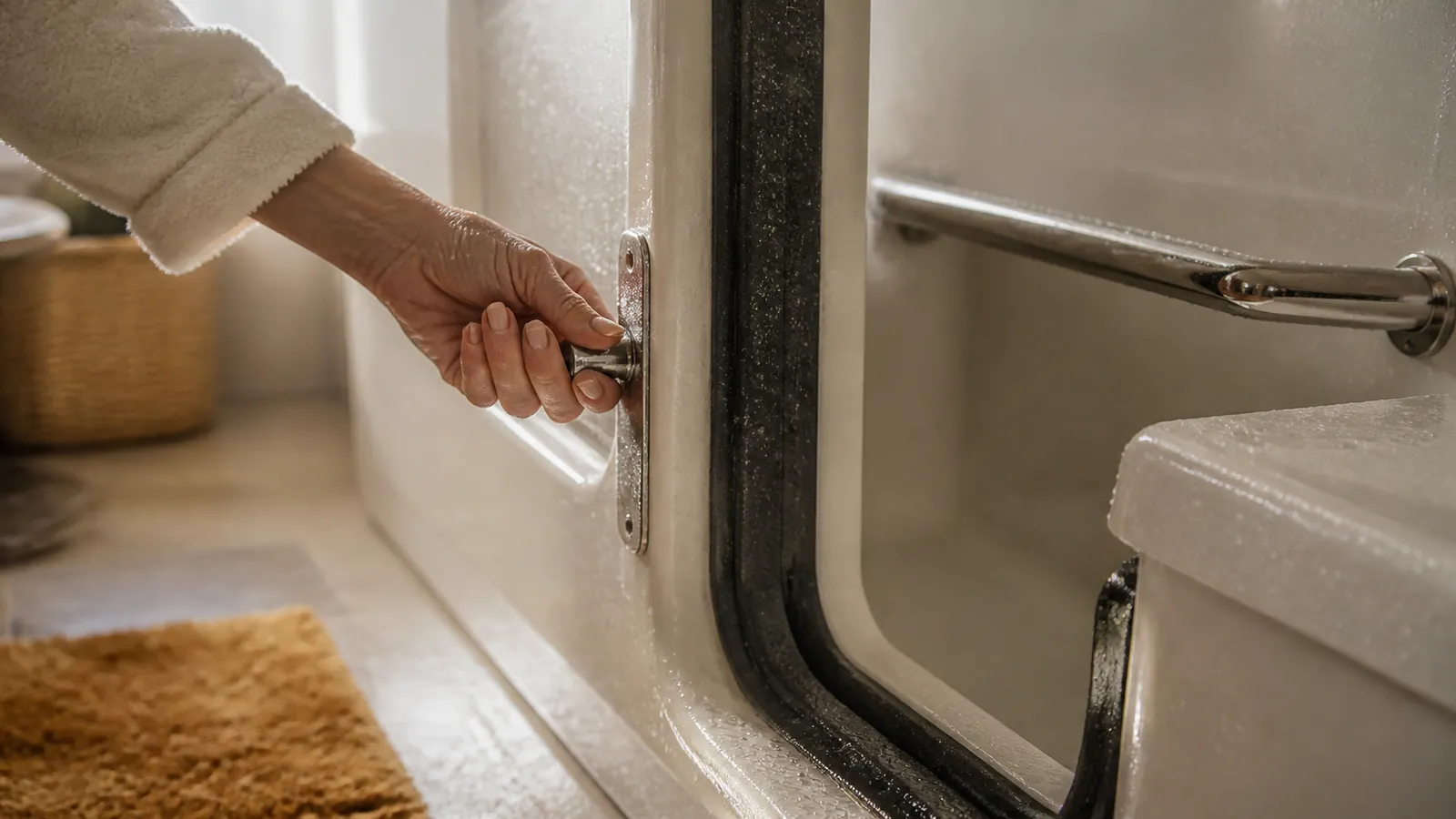
Door and transfer geometry. Ask how the door opens (inward or outward), what its clear width is, whether the seat height suits your parent's transfer, whether there's room for their body and legs, and whether a caregiver could assist if ever needed. Ask, too, whether your parent can reach and operate the door latch, drain control, and faucet from the seated position — dexterity and reach are part of fit, and a supervised dry run in a showroom answers more than any spec sheet. "ADA-compliant" on a brochure is a design standard, not a verdict that this door and seat fit this person; only a measurement and, ideally, a supervised trial answers that.
Threshold. Take the exact dimension from the current manufacturer specification, not a brochure adjective — Kohler, for example, lists a 3-inch step-in threshold for its walk-in bath as of the July 20, 2026 check, and other models differ. A lower threshold reduces the step; it does not eliminate transfer or balance risk.
The least expensive configuration. If budget is the binding constraint, NCOA's own answer is a non-jetted soaker in fiberglass rather than acrylic (March 2026) — but price the trade-off honestly: fiberglass is lighter and easier to install, and less durable over time. A cheap tub your parent stops using, or that fails outside its warranty, is not the low-cost option.
Soaker versus air, whirlpool, or hybrid systems. Every added system brings requirements: dedicated power, plumbing capacity, a cleaning and maintenance routine, and its own warranty terms. Ask what each system adds to each column of the quote — and specifically whether it changes the electrical row, the water-heater row, or the upkeep your parent is realistically willing to do — then compare on those facts rather than on promotional therapy language.
Fill and drain. Unlike a standard bath, the person enters before the water starts and stays seated until it fully drains. Kohler's FAQ notes that fill and drain times vary with a home's water pressure and plumbing, so whether your parent can wait comfortably — and stay warm while waiting — is a genuine fit criterion, not a detail. Ask each bidder to estimate fill and drain times for your parent's actual water pressure, in writing, rather than repeating a brochure figure.
Water heater and warranty. Both belong on every quote as their own line, and each has its own answer under Frequently asked questions.
If any of these criteria is uncertain for your parent, the professional assessment described under When is a walk-in tub not the right first step? comes first.
How do you compare two walk-in tub quotes?
Two proposals for the same bathroom can differ by thousands — one bidder scoping a straight retrofit, the other pricing wall repair and a heater upgrade the first one quietly excluded. That gap is usually not a discount. It is a difference in what each bidder agreed to do, and it stays invisible until both proposals are written in the same units.
The Walk-In Tub Quote Normalizer below is Aging Parent HQ's editorial comparison method — not a contractor estimate, an appraisal, a medical screening, or a guarantee. It does one job: it forces two proposals into the same units so the exclusions, assumptions, and change-order risk become visible before you sign.
Start by giving both bidders the same specification: the exact model or an equivalent configuration, dimensions, door orientation, finish, and the features your parent actually needs, with everything else marked optional. Then, during each in-home estimate, have every line classified in one of six states.
| Price state | What it means on the proposal | What it does to your total |
|---|---|---|
| Included | Named and covered inside the quoted price | Nothing — if the scope description is specific enough to hold |
| Fixed price | A named amount that cannot move without a change order | Nothing |
| Allowance | A placeholder for work not yet fully scoped | Can rise once work begins; ask what would convert it to a fixed price |
| Unit price | A rate per item, foot, or hour, with the quantity still open | Rises with quantity; get the expected quantity in writing |
| Excluded | Named and deliberately not covered | Becomes a second project with its own cost — price it before you compare |
| Unknown | The bidder cannot answer yet | Never write an unknown down as zero; an unknown left out of the math quietly understates the project |
Never let an unknown be written down as zero.
| Field group | Make both quotes state, in writing |
|---|---|
| Product identity | Brand, exact model, size, material, door orientation, tub type, included fixtures, and finish |
| Fit evidence | Measured bathroom footprint, access route and doorways, seat and door clearance, threshold height, and any user trial or professional assessment |
| Delivery and removal | Freight and home protection; old tub or shower removal, hauling, and disposal |
| Installation labor | The named installing entity, the trades included, estimated crew days, and cleanup |
| Plumbing | Supply and drain changes, valves, shutoffs, pressure and flow, drain capacity, and allowance versus fixed price |
| Electrical | Dedicated circuits and GFCI protection, pump or heater wiring, panel work, and related permits |
| Hot-water system | Tub capacity, desired fill temperature, heater capacity and recovery, and who prices any upgrade |
| Structure and finishes | Subfloor and framing, hidden water damage, walls and surround, waterproofing, tile, paint, trim, and access panels |
| Permits and code | Who pulls permits, which fees are included, inspections, and license and insurance evidence |
| Options | Jets, heated seat or backrest, fast fill or drain, shower package, extra grab bars, wall kits, cleaning system — essential separated from optional |
| Price status | Each line marked with one of the six states above; taxes; written discounts; promotion expiration |
| Change orders | The trigger, documentation, approval before work continues, labor and material markup, and your right to decline or revise |
| Schedule | Lead time, installation duration, bathroom downtime, permit dependencies, and delay terms |
| Warranty and service | Product and parts, labor, installation workmanship, seal and caulk coverage, service-call and travel charges, exclusions, transferability, and the claims contact |
| Financing | Cash price, down payment, amount financed, APR, term, total scheduled payments, fees, deferred-interest trigger, prepayment terms, and any lien or security language |
| Final status | Complete · needs clarification · not comparable |
How to read a filled sheet. Before you look at either total, count four things per proposal: fields answered, allowances, exclusions, and unknowns. Then apply three rules. A proposal carrying an unknown in any material field is not comparable yet, whatever its total says. A proposal with more exclusions is not cheaper — it is smaller, and the difference is a second project you have not priced. And a bidder with more fixed prices and fewer allowances is usually the one who looked hardest at the room, which often makes the higher number the more honest one. The sheet's job is to make the higher number explainable, not to pick the lower one.
Some guides — ConsumerAffairs among them — recommend collecting three bids. Two proposals normalized to the same written specification will tell you more than three that are not, and every in-home estimate is a sales visit your parent has to sit through. If a third bidder would close a specific open field, add one; adding bidders to feel thorough is not the same as adding information.
What happens if something is found behind the wall?
Two field groups do the most protective work. On change orders, record exactly what happens if hidden water damage, undersized wiring, inaccessible shutoffs, or a structural problem turns up once the wall is open: what triggers a change order, how it is documented, whether work pauses for your approval, what markup applies, and your right to revise or decline. On schedule and accountability, record who supplies each trade, the license and insurance evidence for each, who is responsible for permits, and how the final inspection is handled — vendors' own installation pages, such as Safe Step's, describe multi-trade workflows spanning plumbing, electrical, structure, removal, and permits, which is precisely why one line reading "installation" is not a scope.
What should you ask for on quote day?
On quote day itself, walk the estimator through the access route and the bathroom, and expect real measuring — a proposal produced without a tape measure is an opening bid, not a scope. Ask for the license and insurance evidence, the installing entity's exact legal name, and every promotion's written terms and expiration before the presentation ends, and treat the worksheet's unanswered rows as your follow-up list. A legitimate bidder expects you to compare proposals and will hold the quote open long enough for you to do it; print or copy the Normalizer field list twice — one sheet per bidder — and fill them in during each visit rather than reconstructing the conversation afterward. You never need to sign during a visit, and a price that is only available today is a pressure tactic, not a price.
And you usually have three business days to cancel. Under the FTC's cooling-off rule for sales made at home, a seller taking an order for $25 or more during an in-home visit must disclose the buyer's right to cancel within three business days, and under the rule itself must hand over a dated contract and a completed cancellation notice at the time of signing. It applies even when your family invited the salesperson to present. Narrow exclusions exist and some states give buyers longer, so confirm the cancellation terms that apply in your parent's state, and put any cancellation in writing inside the window rather than by phone. High-pressure selling into an older homeowner's living room is a recognized pattern in this category; how to protect a parent from pressure sales and fraud covers the wider version of it. (Federal rule pages checked August 10, 2026.)
If your parent already signed. Inside the three-business-day window, cancel in writing and keep proof of the date you sent it. If the seller never handed over the dated contract and completed cancellation notice the rule requires, that failure is itself worth raising — take it to your parent's state consumer protection office rather than arguing it with the salesperson. Past the window, the agreement is generally binding, but the routes stay open: the state or county body that licenses the installing trade, your parent's state consumer protection office through USAGov's state directory, the Federal Trade Commission at ReportFraud.ftc.gov, and — if your parent was targeted because of age, isolation, or a change in memory or judgment, or if money is moving in ways nobody can explain — Adult Protective Services in your parent's county, reached through the Eldercare Locator at 1-800-677-1116. Making that call is not an accusation against your parent, and it is not a decision you have to justify to a seller.
Compare quotes only when they price the same scope. "All inclusive" is a phrase, not a written scope of work. The second-quote rule is simple: do not compare totals until both proposals have answered every material field above, and do not select a quote that still carries unresolved material fields. If one bidder resists itemizing, that reluctance is information too.
How should you compare cash and financing offers?
A monthly payment is not a total cost. Compare complete projects with two formulas, using the classified numbers from your normalized quotes.
Cash project price = tub and equipment + delivery + removal and disposal + installation labor + plumbing + electrical + water-heater work + structural and surface repair + permits and inspection + options + taxes and fees − written discounts.
All-in financed project cost = down payment + total scheduled payments + loan and administrative fees + any balloon or final payment. Record separately, in their own fields: the amount financed, the APR, the term, the deferred-interest trigger and payoff deadline, prepayment terms, and any lien or security language.
Use consistent dollar amounts, note whether tax is inside the total, and mark any component you cannot price as unknown rather than zero. Subtract a discount only when its written expiration date and eligibility terms are in hand. And treat promotional "no interest" language as incomplete until you can see the exact payoff deadline and what happens to accrued interest if any balance remains past it.
Before comparing a financed offer against a cash price, confirm the two describe the identical project scope — financing conversations have a way of quietly changing the configuration — and ask whether any cash discount exists in writing, since subtracting an unwritten discount makes the financed path look artificially close. Then read the contract fields that surround the money: the deposit amount and when it is due, the cancellation terms, what happens to the price and schedule if financing is declined, and whether the agreement places a lien or other security interest on the home. If any of those is unclear, the quote's final status is needs clarification, not complete.
Keep the financing decision separate from the bidding decision. The FTC's consumer guidance on home repair scams describes the pattern to watch for: pressure to act quickly, a push toward cash payment, or a financing agreement that puts the house at risk. None of that means seller-arranged financing is always wrong — it means the loan deserves the same itemized scrutiny as the tub, from someone who is not selling the tub.
If the financing terms on offer look expensive, that is information about the project's affordability rather than a problem to solve with a longer term — work through what if the cost is out of reach? before accepting a rate. Never sign financing to hit a monthly number a salesperson suggested. Coverage from Medicare, Medicaid, VA benefits, or long-term-care insurance is individual and program-specific — see what Medicare covers and what VA benefits and Medicaid may cover below before assuming any offset — and a salesperson's mention of tax deductions or program payment is a claim to verify with a licensed tax adviser or the program itself, never a promise.
Whose contract is this?
Before quotes arrive, settle who is buying. If the bathroom is your parent's and the money is your parent's, the contract is your parent's — their name on it, their signature, their financing application. A competent adult signs their own contracts, and a bidder who offers to let you sign instead is creating a problem for both of you.
If your parent wants you to handle it, a durable power of attorney for finances is what makes that possible, and it has to be in place before it is needed — see what a financial power of attorney does and how it differs from a medical one. Without one, you can gather quotes, ask questions, take measurements, and sit in on the visit; you cannot commit your parent's money. If your parent's capacity to make this particular decision is genuinely in question, that is a conversation for their clinician and an elder-law attorney, not for a sales appointment.
If more than one adult child is involved, settle four things before the first estimator arrives rather than after two proposals are on the table: the budget ceiling, who makes the final call, who attends the visits, and who holds the documents. Money contributed by a sibling does not transfer the decision — if your parent has capacity, the choice is theirs even when someone else is paying, and a family that agrees on that in advance argues about scope instead of about authority. And notice where the risk actually sits: financing secured against the house is secured against your parent's house, and a contractor's lien would attach to your parent's home, not yours.
If your parent rents, or lives in a condominium or in someone else's home, the permission question comes before the price question — a permanent alteration needs the owner's or association's written approval before anyone measures.
This is general information rather than legal advice. An elder-law attorney licensed in your parent's state can answer the authority questions for your family's actual situation.
When is a walk-in tub not the right first step?
A walk-in tub may support safer bathing for the right person, but it is not a complete fall-prevention plan — for the broader work of lighting, footwear, medication review, and strength and balance, see fall-prevention steps for an older parent. The CDC's guidance on older-adult falls is that falls are common but largely preventable when risk is addressed as a whole, and its STEADI framework gives clinicians a screen–assess–intervene approach worth raising at your parent's next appointment.
Choose a different path first when any of these is true:
- Your parent doesn't want it or won't use it. Their preference is not an obstacle to manage; it is the controlling fact. Start with the conversation, and try a reversible smaller change first.
- Transfer, seat, door, or body fit is uncertain. Ask a clinician or occupational therapist for an individualized home assessment rather than relying on a showroom label — marketing compliance language is not a personal fit verdict.
- Waiting is the problem. If your parent cannot wait comfortably and safely while the unit fills and drains, or cannot operate the door and controls reliably, this design works against them regardless of price.
- A different tool matches the task. A curbless or roll-in shower, a transfer bench, a bath lift, a handheld shower, professionally installed grab bars, or better lighting may fit the actual difficulty better — the two option tables compare them on the same fields, and the room-by-room aging-in-place checklist sequences them smallest-change-first.
- The project is disproportionate. When the bathroom or the home's systems need extensive changes relative to the need, price the simpler alternative before committing. And if a move is likely within a few years, treat the tub as an expense rather than an investment — NCOA, citing ConsumerAffairs, reports that buyers usually do not recover the cost at sale (March 2026, a nonprofit source relaying a commercial one).
- Something just changed. A recent fall, a new functional change, or an urgent symptom needs clinical evaluation before any renovation decision — the medical question comes first, and the purchase can wait.
None of these is a verdict about your parent — they are sequencing rules. Most sequences start with a reversible trial: a transfer bench or a professionally installed grab bar can be tested for a month and removed, which makes it an easy first experiment and an honest source of information about what your parent actually needs. If you do book an assessment, expect the evaluator to watch the actual bathing transfer, measure the room and access route, and recommend a modification type rather than a brand; bring the Walk-In Tub Quote Anatomy Matrix and the assessor's notes to any quote appointment that follows. And if the answer for now is "no change yet," that is a legitimate outcome of a good process, not a failure of it.
What if the cost is out of reach?
Cost is a reason to change the plan, not a reason to end the conversation. Every route below follows your parent's county and your parent's state, not yours.
- Start with the free changes. A conversation, a medication review at an appointment that is already scheduled, better lighting, and removing a loose rug cost nothing and address risks a tub does not — fall-prevention steps for an older parent sequences them.
- Call the Area Agency on Aging that covers your parent's county. The Eldercare Locator, a public service of the federal Administration for Community Living, connects families to their local Area Agency on Aging by zip code or by phone at 1-800-677-1116. Local home-modification and home-repair programs, where they exist, are usually reached this way.
- Ask your parent's state about waiver-funded home modification. Some state Medicaid home and community-based services programs pay for bathroom modifications and some do not, with their own eligibility rules, covered-item lists, and waiting lists. Ask the Aging and Disability Resource Center in your parent's state rather than assuming it either way, and see ways to pay for senior care and home modifications.
- If your parent is a veteran, the VA benefit built for bathroom access is HISA, and it is not limited to service-connected conditions — see the coverage question in the FAQ below before you conclude that VA cannot help.
- If your parent owns a home in a rural area, USDA's Single Family Housing Repair Loans and Grants program, known as Section 504, makes loans to very-low-income homeowners to repair or modernize a home and grants to very-low-income homeowners aged 62 and older to remove health and safety hazards. The property must sit in an eligible rural area, and applications go through the USDA state office (checked August 10, 2026).
- If nothing fits yet, say so out loud and set a date to look again. A decision postponed with a reason and a review date is a different thing from a decision avoided.
What to verify in your parent's state
Three things on this page are set locally rather than nationally, and each one can change the cost or the risk of the same purchase. This table covers every U.S. state and territory by routing each question to the body that governs it. It does not publish per-state license requirements, cancellation periods, or waiver coverage lists, because no source reviewed for this page publishes them in a form that meets the standard used for the figures here — a stated scope, a publication year, a direct source, and a date checked. Every route below reaches an authority that can answer for your parent's state today. (Routing sources checked August 10, 2026.)
| What varies by state | Who governs it | How to check today |
|---|---|---|
| Whether the installing entity must hold a state license or registration, and what it covers | Some states license home-improvement and general contractors statewide, some leave it to counties or cities, and some regulate only individual trades such as plumbing and electrical | Start at USAGov's state consumer protection directory, which lists an office for every state and territory; ask that office which body licenses the trade doing your parent's work, then verify the exact legal entity named on the proposal — the FTC's standard is to confirm the license with the state or county government where your parent lives |
| How long your parent has to cancel a contract signed at home | The FTC's three-business-day right is a federal floor; state home-solicitation laws can allow longer, and several states add protections specific to older buyers | Ask your parent's state attorney general's consumer protection division before signing, through USAGov's state attorneys general directory. Get the answer in advance — the window is too short to research from inside it |
| Whether Medicaid pays for bathroom modification | Your parent's state Medicaid agency, through its home and community-based services waivers — each with its own covered-item list, eligibility rules, and waiting list | Check which programs your parent's state operates on Medicaid's State Waivers List, then call the Aging and Disability Resource Center in your parent's state through the Eldercare Locator or 1-800-677-1116 to ask which one covers home modification and what the current wait is |
Frequently asked questions
How much should installation add to a walk-in tub?
No single percentage or dollar figure holds nationally, and the sources on this page fold installation into their totals differently, so a quoted "typical install cost" deserves skepticism. NCOA separates a basic retrofit at $1,000–$2,500 from an advanced remodel at $3,000–$5,000 or more (March 2026) — a useful distinction to raise at a quote appointment, but not a price for your parent's bathroom. Installation depends on the room: removal and disposal, plumbing and electrical work, water-heater changes, hidden repairs, permits, and local labor rates. Require the installation portion itemized line by line rather than accepting a bundled figure.
Will the home need a larger water heater?
Sometimes — and the quote must answer it, not assume it. Compare the tub's fill capacity and your parent's preferred temperature against the current heater's capacity and recovery rate, and require the proposal to state whether any change is included, an allowance, or excluded. Vendors themselves flag water-heater capacity as a potential added cost, as Kohler's own price guide does.
How long does walk-in tub installation take?
Vendors advertise installation "in as little as" a day or two — treat that as the vendor's best case, not a promise. The realistic clock is set by the slowest dependency: your parent's own readiness and decision timeline, which is a legitimate part of the schedule; quote appointments; local permit review; hidden repairs found once the old tub is out; water-heater or electrical trade work; and final inspection.
Does Medicare pay for a walk-in tub?
Do not assume it. Original Medicare covers durable medical equipment that meets its official definition — reusable items with a medical purpose, used in the home — and a walk-in tub is a permanent alteration to the bathroom rather than a piece of equipment. The National Council on Aging states it plainly: Original Medicare will not cover walk-in tubs, because they are not considered durable medical equipment (March 2026).
Medicare Advantage is a separate question with a separate answer. Part C plans can offer supplemental benefits Original Medicare does not, and some may help with home modifications or safety equipment; whether a specific plan does depends on that plan, and NCOA notes that restrictions commonly apply. The answer lives in the plan's Evidence of Coverage, not in a sales brochure. Verify it free, in your parent's own plan: call the plan directly, call 1-800-MEDICARE, or speak to a counselor at the State Health Insurance Assistance Program in your parent's state — SHIP is federally funded through the Administration for Community Living, the counseling is free, and SHIP counselors do not sell insurance. Aging Parent HQ does not sell or recommend Medicare plans of any kind. For the wider set of funding pathways, see ways to pay for senior care and home modifications. (Medicare and SHIP sources checked August 10, 2026.)
Will VA benefits or Medicaid help pay for a walk-in tub?
Possibly, and the VA answer is more specific than most pages make it. The VA benefit built for bathroom access is Home Improvements and Structural Alterations (HISA), administered through VA's Prosthetic and Sensory Aids Service rather than through the housing-grant programs. It covers medically necessary alterations to a veteran's primary residence, including use of essential lavatory and sanitary facilities — VA's own example is a roll-in shower — and it requires a prescription written or approved by a VA physician. It is not limited to service-connected conditions: VA publishes a lifetime benefit of $6,800 for a service-connected disability, or for a non-service-connected disability where the veteran holds a service-connected rating of at least 50 percent, and $2,000 for other eligible veterans.
Two cautions before counting on it for this purchase. VA's published exclusions include the purchase or installation of spa, hot tub, or Jacuzzi-type tubs, so whether a specific walk-in tub qualifies is a determination for the Prosthetic and Sensory Aids Service at your parent's VA facility — ask before signing, not after. And the larger VA disability housing grants, SAH and SHA, are a separate path with their own service-connected rules. Apply through VA directly; never pay anyone to file a VA benefit application.
Medicaid is state-specific: some state home and community-based services waivers pay for bathroom modification and some do not, each with its own eligibility rules and waiting lists. Start with the routes under What to verify in your parent's state. (VA and program pages checked August 10, 2026.)
Is a walk-in tub tax deductible?
Sometimes, partly, and only if your parent itemizes. IRS Publication 502 treats a permanent home improvement whose main purpose is medical care as a capital medical expense: the deductible amount is the cost of the improvement reduced by any increase in the home's value, and if the improvement adds no value, the whole cost counts. Publication 502 also states that improvements made to accommodate a home to a disabled condition usually do not increase the home's value, and it lists modifications to bathrooms among its examples — it does not name walk-in tubs specifically. Medical expenses are deductible only to the extent they exceed 7.5% of adjusted gross income, and Publication 502 provides a worksheet for the capital-expense calculation.
A salesperson's statement that the tub is deductible is a sales claim, not a determination. Take it to a licensed tax adviser, who will want the medical justification and — where the value question is live — an appraisal. (IRS source checked August 10, 2026.)
What should a walk-in tub warranty include?
A marketing "lifetime warranty" label is not enough. Require the complete written warranty document and confirm each field separately: product and shell, parts, labor, installation workmanship, door seals and caulk, service-call and travel charges, exclusions, transferability if the home is sold, and the claims contact and response process. If the full document is not available before signing, treat warranty coverage as unknown.
What does a walk-in tub cost to own after installation?
No source reviewed for this page publishes a service-life, service-cost, or operating-cost figure for walk-in tubs that meets the standard applied to the installed-price figures above, so this page will not estimate one. What you can do is make the bidder put the ownership numbers into the proposal: the expected service life and what the warranty still covers in years three and five; who services a leaking door seal locally, and what a service call and travel charge cost once any included period ends; the tub's fill capacity, which sets how much water and water heating each bath uses compared with your parent's current tub; and the upkeep any jetted or air system needs, and how often. A bidder who cannot answer those questions is telling you something about the service you would be buying.
How this page was researched
Aging Parent HQ is an independent educational publisher. It is not a contractor, a dealer, a home-care or placement agency, a law firm, a tax adviser, an insurer, or a government agency, and nothing here is individualized medical, legal, tax, or financial advice.
What has to be true before a figure appears here. Every cost figure carries four things: what it covers, the year it was published, a direct link to the document it came from, and the date that document was checked. A figure that cannot carry all four does not appear — which is why several cells on this page read "Not verified on this page" and route you to a real number instead.
How sources are ranked. Official rule and program sources first: Medicare, Medicaid, VA, IRS, USDA, FTC, CDC. Then primary data and recognized nonprofit organizations. Provider documentation is used only for claims about that provider and is labeled as the provider's own claim. Commercial publishers funded by lead generation are labeled as such wherever they appear, including in the source table above.
No rankings, no scores, no picks. This page does not rank brands, score products, or name a best walk-in tub. It describes option types on identical fields and makes conditional picks tied to your parent's situation. How this page is funded: Aging Parent HQ is supported by advertising and, on some pages, disclosed referral links. No provider has paid for placement, ordering, or inclusion on this page, and compensation never determines what is included or how it is ranked. If a compensated link is added to this page, it will be disclosed here.
Refresh. Cost figures and provider terms are re-checked at least twice a year and after any known price change; federal program figures are re-checked at least annually. The verification dates on this page state when each was last confirmed, and corrections are made on the page itself with a revised date — to report an error, email hello@agingparenthq.com.
Your next step
Start where this page started: with your parent, not with a price. Confirm together that a walk-in tub is the change they want and can use — and if fit is uncertain, book the professional assessment first. Then measure the bathroom and access route, copy the Normalizer fields onto two sheets, define one essential specification, and request two itemized proposals that cover the same scope. Compare the all-in cash totals, put any financing through the financed-total formula, and read the warranty and change-order fields before you read the bottom line. If the two quotes land far apart, the worksheet will usually show you why — a scope difference, an exclusion, or an allowance — and that difference, not the bottom line, is the real conversation to have with each bidder.
Whatever you decide about the bathroom, talk with your parent's doctor about their overall fall risk. A bathroom is one room; a fall-risk review covers medications, vision, strength, and balance, and it can happen at a visit that is already on the calendar.

Sources and last verified date
Cost figures and vendor terms were last checked July 20, 2026 and are dated at each point of use. The federal program, tax, consumer-protection, and state-routing sources below were checked August 10, 2026.
- How Much Do Walk-In Tubs Cost? — National Council on Aging — March 13, 2026 type-based installed cost bands (basic, hydrotherapy, luxury), the separate equipment and installation ranges those bands are built from, the basic-retrofit and advanced-remodel installation split, the Original Medicare and Medicare Advantage positions, and the resale observation.
- How Much Do Walk-In Tubs Cost? — ConsumerAffairs — 2026 broad standard and high-end installed ranges and line-item cost drivers; commercial lead-generation publisher, used as context alongside other sources.
- Walk-In Tubs Product Catalog — American Standard — direct-retail product list prices ($6,634.55 and $6,853.60) and stock status at the July 20, 2026 check.
- Walk-In Tub Home Services — American Standard — the vendor's stated $10,000–$25,000 customer installed-project range and its described installation scope.
- Kohler Walk-In Bath — main product page — quote-required sales model, 3-inch step-in threshold specification, and warranty and installation descriptions.
- Kohler Walk-In Bath — Price and Cost Guide — vendor-acknowledged cost drivers, including water-heater capacity.
- Kohler Walk-In Bath — FAQs — fill and drain time variability with household water pressure and plumbing, and old-tub removal.
- Walk-In Tub Pricing Guide — Safe Step — vendor-stated product and installation ranges and quote-required workflow, treated as vendor claims.
- Installation Services — Safe Step — vendor-described multi-trade installation workflow covering plumbing, electrical, structure, removal, and permits.
- Cooling-Off Period for Sales Made at Home or at Certain Other Locations — Federal Trade Commission — the federal three-business-day cancellation right for in-home sales and the seller's disclosure obligation.
- 16 CFR Part 429 — Cooling-Off Rule text, eCFR — the $25 residence threshold, the rule's application to sales following a buyer's invitation, and the required dated contract and "Notice of Cancellation" form.
- How To Avoid a Home Improvement Scam — Federal Trade Commission — the licensing and insurance verification standard for hiring a contractor, checked with state or county government.
- Home Repair Scams — Federal Trade Commission — the documented pressure, cash-payment, and risky-financing patterns in home repair sales.
- ReportFraud.ftc.gov — Federal Trade Commission — the federal reporting route for deceptive or high-pressure sales practices.
- State Consumer Protection Offices — USAGov — the federal directory listing a consumer protection office for every state and territory, used for licensing questions and post-signing complaints.
- State Attorneys General — USAGov — the federal directory used to reach the office that administers state home-solicitation cancellation rules.
- About Older Adult Fall Prevention — CDC — falls among older adults are common and can be prevented through broad risk reduction; supports the fall-prevention boundary.
- About STEADI — CDC — the clinical screen–assess–intervene fall-prevention framework referenced for professional follow-up.
- Durable Medical Equipment (DME) Coverage — Medicare.gov — the official DME definition, covered-equipment examples, and the coverage-verification pathway.
- State Health Insurance Assistance Program — Administration for Community Living — the federally funded, free Medicare counseling program used to verify a specific plan's benefits.
- SHIP National Technical Assistance Center — the directory used to reach a SHIP counselor in the parent's state.
- Publication 502, Medical and Dental Expenses — Internal Revenue Service — the capital-expense rule for medically motivated home improvements, the value-offset calculation and worksheet, the treatment of disability accommodations, and the 7.5% adjusted-gross-income threshold.
- Home Improvements and Structural Alterations (HISA) — VA Prosthetic and Sensory Aids Service — covered purposes including essential lavatory and sanitary facilities, the VA physician prescription requirement, the $6,800 and $2,000 lifetime benefit amounts, and the published exclusions including spa, hot tub, and Jacuzzi-type tubs.
- Disability Housing Grants for Veterans — VA.gov — the official eligibility framework for VA SAH and SHA home-adaptation grants for veterans with qualifying service-connected disabilities.
- State Waivers List — Medicaid.gov — the official list of home and community-based services waiver programs operated by each state.
- Eldercare Locator — Administration for Community Living — the federal routing service connecting families to local aging services, Aging and Disability Resource Centers, and Adult Protective Services by the older adult's location.
- Area Agencies on Aging — Administration for Community Living — the local agency network that administers community home-modification and support programs.
- Single Family Housing Repair Loans and Grants (Section 504) — USDA Rural Development — loans for very-low-income rural homeowners and grants for those aged 62 and older to remove health and safety hazards.
Last verified: August 10, 2026
Next review: February 10, 2027
Safe Step Walk-In Tub
The best-known walk-in tub, installed by their own crews — quotes are free and the bathroom is where most falls happen.
Get a free quoteKohler Walk-In Bath
The name-brand option with strong install network and frequent promo pricing — worth a second quote against Safe Step.
Request Kohler pricing